 VERDVIT
Wormhole-Collision Simulations Sketch Possible Gravitational-Wave Bursts
A new, not-yet-peer-reviewed numerical-relativity preprint explores hypothetical binary Ellis–Bronnikov wormholes. Its simulations predict scattering, inflation, horizon formation and short gravitational-wave bursts, but do not show that wormholes exist or connect the model to a real detector event.
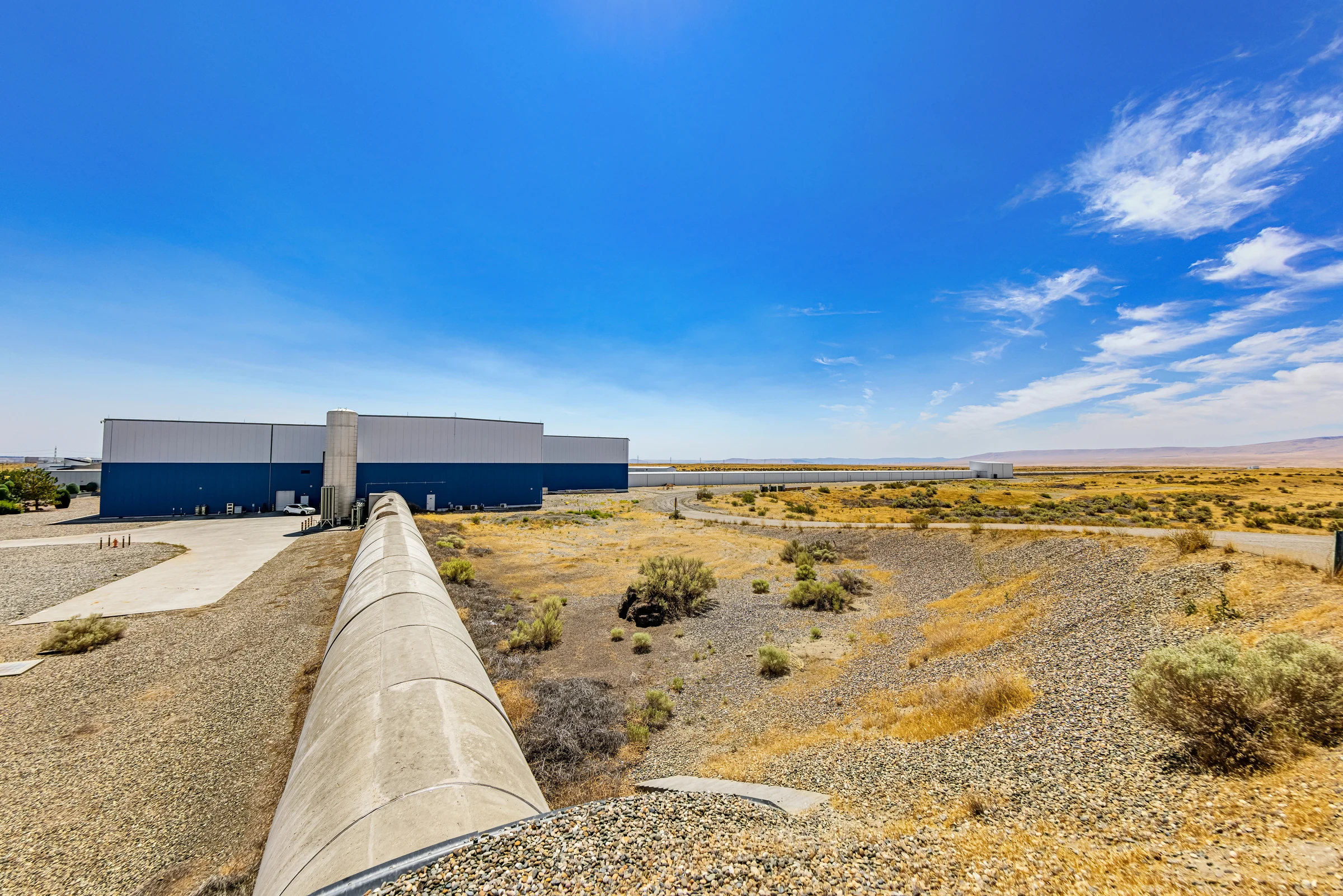
The LIGO Hanford gravitational-wave observatory in Washington, photographed for NOIRLab on 29 December 2023. This is a genuine archive photograph of a real detector facility used as contextual imagery; it does not depict a wormhole, a collision or a current event. Credit: NOIRLab/LIGO/NSF/AURA/T. Matsopoulos. Creative Commons Attribution 4.0 International (CC BY 4.0). The original JPEG is preserved unchanged. hero.webp is a deterministic resize/re-encoding for web preview at 2400x1601; the original framing and content are preserved. Photo source and reuse terms.
A new simulation has explored what might happen if two hypothetical Ellis–Bronnikov wormholes interacted. The model produced outcomes including scattering, rapid expansion of the wormhole mouths and formation of a common apparent horizon. The researchers say the encounters could produce short gravitational-wave bursts rather than the familiar rising “chirp” associated with many merging black holes. [1] [2]
The result is a theoretical forecast, not an observation. The paper by Nikita M. Shirokov and Ilya Nachevsky was submitted to arXiv on 9 October 2026 and remains a preprint, not a peer-reviewed study. ScienceAlert’s report was published on 17 October 2026. No wormhole has been detected, and no real wormhole collision has been identified in gravitational-wave data. [1] [2]
Key points - The work models binary Ellis–Bronnikov wormholes in three-dimensional numerical relativity. - Simulated encounters can scatter, inflate the throats or form a common horizon before evolving toward a black-hole-like state. - The predicted gravitational-wave signature is a short burst whose frequency track may differ from a black-hole inspiral chirp. - The paper does not show that wormholes exist, and it does not link the model to a confirmed detector event.
What the researchers simulated
Ellis–Bronnikov wormholes are mathematical solutions in general relativity. In the model used here, a hypothetical “ghost” or phantom scalar field holds each throat open. That field has unusual negative-energy properties, and the simulated throat is unstable: a disturbance can push it toward collapse or runaway expansion. [1] [2]
Shirokov, of the Moscow Institute of Physics and Technology, and Nachevsky, of the Higher School of Economics, ran what they describe as three-dimensional numerical-relativity evolutions of wormhole pairs. They varied the initial separation, motion and scalar-field properties rather than claiming that any of those starting conditions occur in nature. [1] [2]
The preprint reports a charge-sign rule in the model. Like scalar charges repel, while opposite signs attract, so only opposite-signed pairs merge in the simulated cases. That is a result of this specific mathematical setup. It is not evidence that astrophysical objects carry such charges.
Why the collision results look unusual
The simulations do not show two wormholes settling into a stable, larger wormhole. In some runs, the pair passed close to one another and separated while both throats expanded. In other runs, the objects moved together and a common marginally outer trapped surface, or MOTS, formed around both throats. [2]
That common surface then shrank by about 28% as the phantom field fell into the collapsing region. The authors say this does not overturn the black-hole area theorem because the simulation concerns an apparent horizon, not an event horizon, and because the exotic field violates assumptions used by the theorem. [1] [2]
What gravitational-wave signal could be left behind?
A conventional black-hole binary often produces a chirp: as the objects spiral inward, the wave grows faster and stronger before merger and ringdown. The simulated wormhole encounters do not follow that simple pattern. The paper describes short bursts, with the detailed shape depending on whether the pair plunges together or makes a close fly-by. [1] [2]
Some of the strongest modelled bursts came from close fly-bys that did not form a common horizon. The preprint also describes a frequency track that can fall during parts of an encounter, rather than rising monotonically like a standard inspiral. A scalar dipole channel appears in the calculations as well, although gravitational-wave detectors measure spacetime strain rather than a scalar field directly. [2]
That is useful as a search idea, not a diagnostic label. Black-hole systems and other compact-object processes can also generate burst-like signals. A short gravitational-wave burst without a textbook chirp would not prove a wormhole origin.
Why LIGO cannot simply confirm this result
LIGO is a pair of four-kilometre laser interferometers in Hanford, Washington, and Livingston, Louisiana. The instruments measure tiny changes in distance caused by passing gravitational waves; they do not photograph the objects producing them. Multiple detectors help establish that a signal is real and improve its sky position. [3]
The preprint itself highlights a major detectability problem. If these hypothetical objects formed in the early Universe, cosmic expansion would stretch their signals to frequencies below the bands of facilities such as LIGO and the planned LISA mission. The authors say a signal in an accessible band would require wormholes to form much later, but no known mechanism currently explains how that would happen. [2]
This means the study does not announce a candidate event. It supplies model waveforms and a set of possible behaviours that researchers could compare with future data, while leaving the existence, formation and astrophysical abundance of wormholes unresolved.
How to read the headline without overclaiming
The strongest conclusion is narrow: under the assumptions of this preprint, binary Ellis–Bronnikov wormholes can produce gravitational-wave bursts with features unlike a simple black-hole inspiral. The result is interesting because it expands the catalogue of signals that numerical-relativity researchers can consider.
The limits are equally important. The work is not peer reviewed, the simulated objects are hypothetical, and the calculations begin from an idealised classical model containing a phantom field. The authors do not report a detector match to a confirmed event. ScienceAlert also cautions that an unusual earlier signal, GW190521, has been discussed in speculative wormhole literature, but the new simulations do not establish a connection to it. [1]
Frequently asked questions
Did scientists detect two colliding wormholes?
No. The study is a computer simulation of hypothetical objects. It does not report a real wormhole, a real collision or a confirmed gravitational-wave detection from one. [1] [2]
Is the wormhole-collision paper peer reviewed?
Not yet. The original preprint was submitted to arXiv on 9 October 2026. The available record identifies it as an arXiv paper, while the ScienceAlert coverage says the research has not been peer reviewed. [1] [2]
What would make the signal distinctive?
The simulations suggest a short burst and, in some cases, a falling or drifting frequency track rather than the steadily rising chirp expected from a standard binary-black-hole inspiral. That pattern would still need to be tested against other astrophysical explanations. [2]
Related reading on Verdvit
- Verdvit Technology section
- Google introduces WeatherNext 3 with hourly, higher-resolution global forecasts
- ISAR spectrum, orbit and Andøya launch context
Sources and research notes
[1] ScienceAlert — Physicists Simulated What Might Happen When Two Wormholes Collide, And Things Got Weird
Source record: https://www.sciencealert.com/physicists-simulated-what-might-happen-when-two-wormholes-collide-and-things-got-weird. Published: 2026-10-17. Retrieved: 2026-10-18T05:49:00Z.
[2] arXiv — Binary Ellis-Bronnikov wormholes in 3+1 numerical relativity: mergers, fly-bys and gravitational waves
Source record: https://arxiv.org/abs/2610.13206. Published: 2026-10-09. Retrieved: 2026-10-18T05:49:00Z.
[3] LIGO Caltech — What is LIGO?
Source record: https://www.ligo.caltech.edu/page/what-is-ligo. Published: undated. Retrieved: 2026-10-18T05:49:00Z.
[4] Wikimedia Commons / NOIRLab — LIGO at Hanford, Washington (LIGO Pic 09-CC)
Source record: https://commons.wikimedia.org/wiki/File:LIGO_at_Hanford,_Washington_%28LIGO_Pic_09-CC%29.jpg. Published: 2023-12-29. Retrieved: 2026-10-18T05:49:00Z.
Reporting checked: 2026-10-18T05:49:00Z. Event date: 2026-10-09. Source records provide attribution; navigation and citation links stay on Verdvit.
Article information
Title: Wormhole-Collision Simulations Sketch Possible Gravitational-Wave Bursts
Description: A 9 October 2026 arXiv preprint models hypothetical Ellis–Bronnikov wormhole encounters and possible gravitational-wave bursts, but reports no detection.
Topics: Wormholes, Gravitational Waves, LIGO, Space Science, Physics, Numerical Relativity, Technology