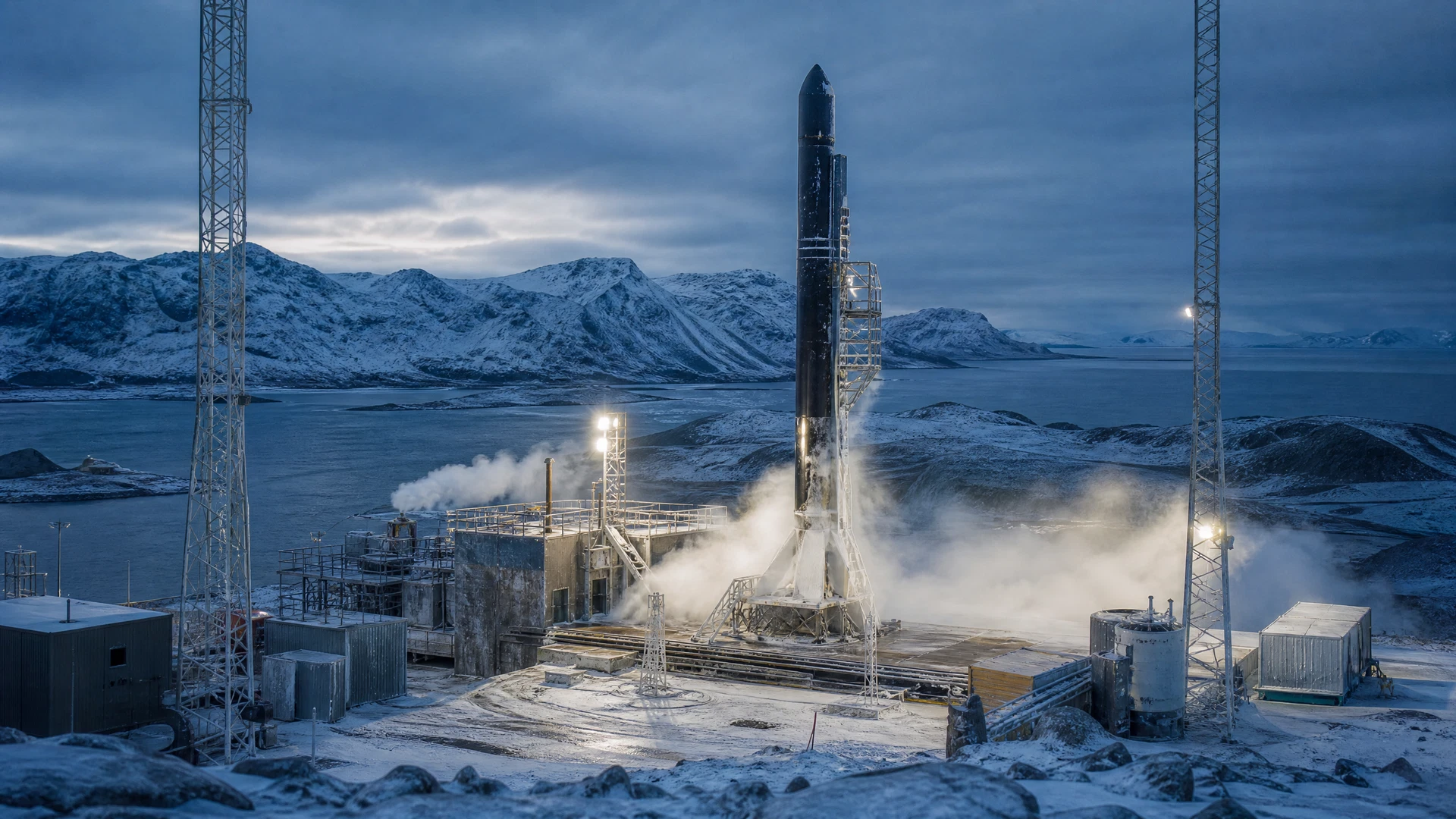
Isar Aerospace’s uncrewed Spectrum rocket reached orbit from Andøya Space in northern Norway on September 5, 2026, making the German startup the first commercial European space company to deliver satellites into orbit from continental Europe. The mission, called ‘Onward and Upward,’ lifted off at 10:12 p.m. local time and completed its orbital flight on the vehicle’s second launch. Reuters described the result as a breakthrough for Europe’s effort to secure independent access to space. [1] [2]
The rocket carried five small satellites and one in-flight technology experiment. Isar said the spacecraft separation was completed, but it was still working with customers to confirm satellite status in its immediate post-launch statement. Independent reporting confirmed that the payloads were deployed as planned; the available sources do not establish the longer-term health or operational performance of every spacecraft. [2] [4]
Key points
- Spectrum reached orbit from Andøya on September 5, 2026, on its second flight. [1] [2]
- The mission carried five CubeSats and one non-deployable scientific or technology experiment. [3] [4]
- The launch followed a failed March 2025 test flight that lasted about 30 seconds. [3] [4]
- Isar says Spectrum vehicles 3 through 7 are already in production, with eventual capacity for up to 40 vehicles a year at a new facility. [2]
- The company has secured about €200 million through the European Space Agency’s European Launcher Challenge and is developing a launch complex in Nova Scotia. [5] [6]
What happened
Spectrum’s second flight was designated a qualification mission as well as the rocket’s first flight carrying payloads. During ascent, the vehicle crossed the Kármán line, completed main-engine cutoff and stage separation, ignited its second stage, and released its payload fairing. Isar’s account says the upper stage then performed a circularization burn before spacecraft separation. [2]
The mission’s six payloads were selected through the German Space Agency at DLR’s Microlauncher Competition. ESA said the group included five commercial and educational CubeSats and an experiment intended to demonstrate technologies in orbit and support student education. That makes the flight more than a demonstration of propulsion and guidance: it also tested the company’s ability to carry customer hardware through the full launch sequence. [2] [3]
Reuters reported that the flight was the first commercial rocket to reach orbit from continental Europe. Space.com independently placed the milestone in Western Europe and reported that the rocket entered an elliptical orbit before performing the burn needed for payload deployment. Russia’s European territory has hosted orbital launches for decades, so the record is geographic and commercial rather than a claim that Europe had never launched a rocket to orbit. [1] [4]
Verified background and context
The achievement followed a difficult first flight. Spectrum’s March 2025 test cleared the launch pad but flew for roughly 30 seconds before failing. Space.com reported that Isar’s investigation identified an unintended vent-valve opening and a loss of attitude control at the start of a roll maneuver as initiating events. No one was injured in the incident, according to Reuters. [3] [4] [1]
ESA’s pre-launch description identified Spectrum as a two-stage rocket about 28 metres tall and two metres in diameter, with ten engines and a target capacity of up to 1,000 kilograms to low Earth orbit. Those figures describe the vehicle’s design target, not the mass delivered by this flight. The second launch therefore provided an important test of the system’s orbital capability, but it did not by itself demonstrate a mature high-cadence service. [3]
The programme has received public support. Reuters reported that Isar secured about €200 million from ESA under the European Launcher Challenge, funding future launch vehicles, testing and launch infrastructure, and missions. ESA said its Boost! programme had supported earlier company development and this qualification flight. [5] [3]
Why it matters
Launch access is a strategic constraint because satellites cannot enter service without a reliable way to reach orbit. Reuters quoted Isar chief executive and co-founder Daniel Metzler describing launch capability as the industry’s largest bottleneck. The company and European officials have framed the Andøya result as a step toward sovereign access for civil, commercial and defence missions, but that framing is an official position rather than proof that Europe has replaced existing launch providers. [1] [3] [5]
For customers, the practical significance is the emergence of another launch option for small and medium-sized spacecraft. A successful qualification flight can reduce technical uncertainty, generate flight data and help a provider move from development contracts toward regular service. The commercial test is still ahead: customers will need evidence of repeatable launches, predictable schedules, competitive pricing and reliable payload operations. This mission established an orbital capability; it did not settle those business questions. [1] [2]
The result also strengthens the case for building a production and launch network around Spectrum. Isar said vehicles 3 through 7 were already in production and that a planned 40,000-square-metre facility would eventually support production of up to 40 launch vehicles each year. That is a stated capacity goal, not a verified annual launch rate. [2]
What remains uncertain
The central event is verified: Spectrum reached orbit and separated its payloads. The status of each satellite after separation remains less clear in the sources reviewed. Isar explicitly said it was working with customers to confirm satellite status, while Space.com reported deployment rather than independent spacecraft commissioning. Readers should therefore distinguish between successful orbital insertion, payload separation and successful long-term mission operations. [2] [4]
The launch also does not demonstrate that the rocket has achieved a sustained cadence. Isar’s goal of around 40 launches a year and its production plans are forward-looking company statements. They depend on future testing, manufacturing, regulatory approvals, customer demand and additional successful flights. Reuters reported that an initial public offering was not currently under consideration, but that statement describes management’s position at the time and is not a permanent financing commitment. [1] [2]
What happens next
Isar’s immediate next step is to complete customer checks on the six payloads and use the flight data to qualify Spectrum for future missions. The company has said it wants to scale production and serve an order pipeline, while ESA’s programme places the flight within a broader European effort to diversify launch services. [2] [5]
A second launch site is part of that expansion. Reuters reported in July that Isar had agreed with Maritime Launch Services to build and use a dedicated Spectrum pad at Spaceport Nova Scotia in eastern Canada. In its post-launch account, Isar said the Canadian complex was being constructed for mid- to high-inclination orbits useful for Earth-observation and communications missions. The company’s earlier reporting, as summarized by Reuters, put possible operations in 2028; that remains a plan rather than an operating date. [6] [1] [2]
The clearest measure of whether this milestone becomes a durable commercial achievement will be repetition. Further flights must show that Spectrum can launch safely, carry customer payloads, deploy them as contracted and maintain a predictable schedule. Until those results arrive, the September 5 mission is best understood as a verified orbital breakthrough and a significant qualification step, not the completion of Europe’s launch challenge. [1] [2] [3] [4]