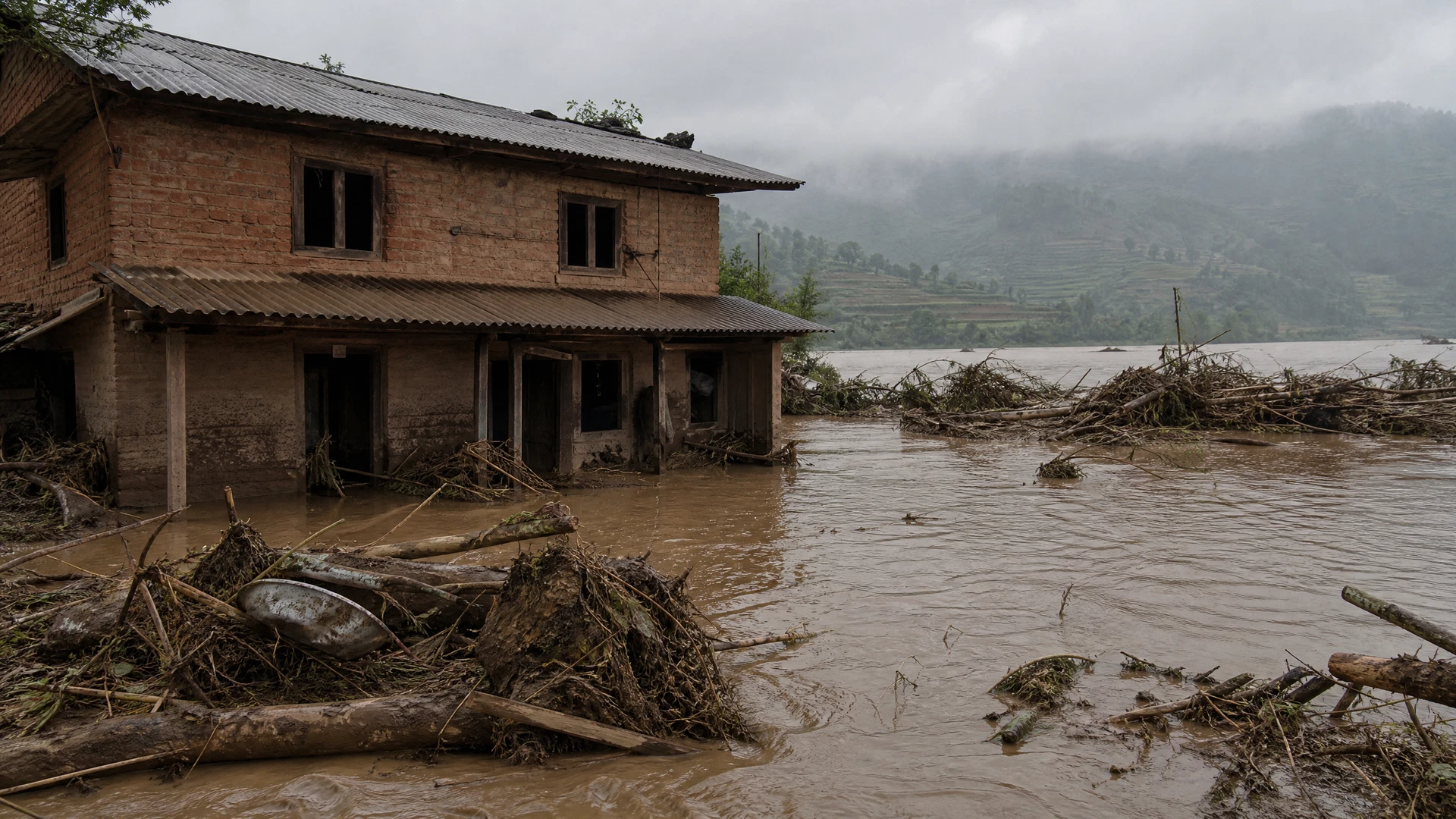
A flash flood on the Budhi Gandaki River in Nepal’s Gorkha district prompted authorities to tell riverside residents to move to safer ground on Sunday, October 11. The flood followed a dry landslide in Chumnubri that blocked the river, sending muddy water downstream and damaging homes, bridges and a hydropower-project camp. [1] [2]
The first reports do not provide one settled casualty or missing-person count. Reuters said five people were out of contact and that 49 people, including a foreigner, had been rescued. [1] Gulf News, citing ANI and a local official, reported 10 people unaccounted for and six people evacuated to safety. [2] Those accounts differ in scope, timing and the way they describe the response; they should not be added together or treated as a final official tally.
Key points
- A dry landslide blocked the Budhi Gandaki River in Chumnubri, Gorkha.
- Authorities urged downstream riverside communities to evacuate to safer places.
- Reuters reported five people out of contact and 49 rescued.
- Gulf News/ANI reported 10 unaccounted for and six evacuated.
- Bridge, house and project-site damage was reported; the figures remain subject to official updates.
What happened
Reuters reported that the landslide in Chumnubri, about 100 km west of Kathmandu, blocked the Budhi Gandaki, a tributary of the Trishuli River. The resulting flood swept away about a dozen houses and two suspension bridges, damaged a hydroelectric-project camp and carried away some construction equipment, according to Nepal’s National Disaster Risk Reduction and Management Authority. Reuters also reported that a highway bridge linking Gorkha with neighbouring Dhading was washed away. [1]
The authority alerted residents along the river in Gorkha, Tanahun, Chitwan, East Nawalparasi and West Nawalparasi districts. Gorkha’s senior bureaucrat, Dharmendra Kumar Mishra, said villagers living along downstream riverbanks had been asked to evacuate and remain safe. Reuters said army and police rescue personnel reached the area and monitored conditions from a helicopter. [1]
The Gulf News/ANI account described a wider bridge impact in Gorkha. It said six bridges were swept away, including two motorable bridges and four suspension bridges, and named crossings near Arughat, Tripurasundari, Soti-Manbu and Dharche. It also reported damage or destruction to bridges connecting Machhikhola with Karauja, Thadobharyang with Jagat, and Ghattekhola with Philim. [2]
That report said nearly 35 houses in Painyu and Bagar in Ward 3 of Chumnubri Rural Municipality were swept away, while settlements in Jagat, Salleri, Dovan and Ghattekhola were damaged. It said a Kathmandu-based Joint Rapid Response Team was airlifted to help, while Nepal Army personnel and helicopters were deployed for search, rescue, relief and evacuation operations. [2]
Why it matters
The immediate risk is not confined to the point where the landslide occurred. A blocked river can create danger upstream and downstream as water levels change, and the reports describe muddy water entering homes and affecting transport links. Gulf News/ANI said officials were monitoring a river level that had continued to rise and fall and urged residents of Sirdibas, Jagat, Salleri, Khorlabesi, Machhakhola, Soti, Arkhet and Arughat—especially those living beside the river—to relocate and remain on high alert. [2]
The reports also show why readers should use location and time with every number. Reuters’ account attributes five people out of contact and 49 rescues to a national disaster authority and the army, while the Gulf News/ANI account separately gives 10 unaccounted for and six evacuated. [1] [2] These may reflect different reporting windows, lists or definitions, but the sources do not reconcile them. The responsible conclusion is that rescue operations were active and the human impact was still being assessed, not that one figure has definitively superseded the other.
The damage also has a practical consequence for response. Washed-away bridges can isolate communities and slow the movement of rescue teams, supplies and information. The accounts describe both air and land deployments, suggesting that access was an operational concern, although neither source provides a complete assessment of road closures or the duration of the disruption. [1] [2]
Context: keep the new event separate
This Gorkha incident is not the same as the earlier nationwide disaster covered on Verdvit’s existing page. That page preserves Nepal Police figures reported on September 3: 1,222 deaths and 4,875 missing people, alongside a warning that the figures were a time-stamped account rather than a continuously updated tally. [3]
The earlier page also records a one-person difference between the stated national death toll and the sum of its district entries. That unresolved discrepancy is another reason not to fold those historical figures into the October 11 Gorkha update. [3] Reuters itself referred to an August catastrophe on another tributary, reporting 1,457 deaths and thousands still missing in that separate event. [1] The figures are different source accounts about different stages or scopes of Nepal’s flood emergency; they are not a single current national total.
What remains uncertain
No source opened for this update establishes a final death toll for the October 11 Gorkha flood. Reuters said there were no reports of casualties in its account, while also reporting five people out of contact. [1] Gulf News/ANI reported 10 unaccounted for but did not report a confirmed death toll. [2] “Out of contact”, “unaccounted for” and “evacuated” are not interchangeable categories, and the available reports do not say whether their lists overlap.
The extent of physical damage also needs further official reconciliation. Reuters reported about a dozen houses and two suspension bridges swept away, plus a highway bridge and a project camp affected. Gulf News/ANI reported nearly 35 houses and six bridges lost or swept away. [1] [2] The difference may reflect changing assessments or wider geographic coverage, but there is no opened official bulletin here that resolves it.
It is also too early to infer the total population affected, the condition of every settlement named in the reports, or whether the river has begun to recede permanently. The accounts describe active monitoring and deployments, not the end of the emergency.
What happens next
The next useful update should come from Nepal’s disaster-management authorities, security forces or local administration and should identify the reporting time, the geographic area covered and the definitions used for missing, rescued and evacuated people. A reconciled list is particularly important where Reuters and Gulf News/ANI report different counts. [1] [2]
For residents, the immediate instruction reported by authorities is to leave riverbank areas for safer locations, remain alert and cooperate with search-and-rescue teams. Gulf News/ANI reported that emergency assistance could be sought through Nepal’s Ministry of Home Affairs number 1234. [2] Whether bridges can be restored, routes reopened and isolated communities contacted will depend on water conditions and access; the sources do not give a timetable.
Verdvit should retain the September figures only as clearly labelled historical context and lead this update with the October 11 Gorkha event. This is factual news reporting, not investment or legal advice.