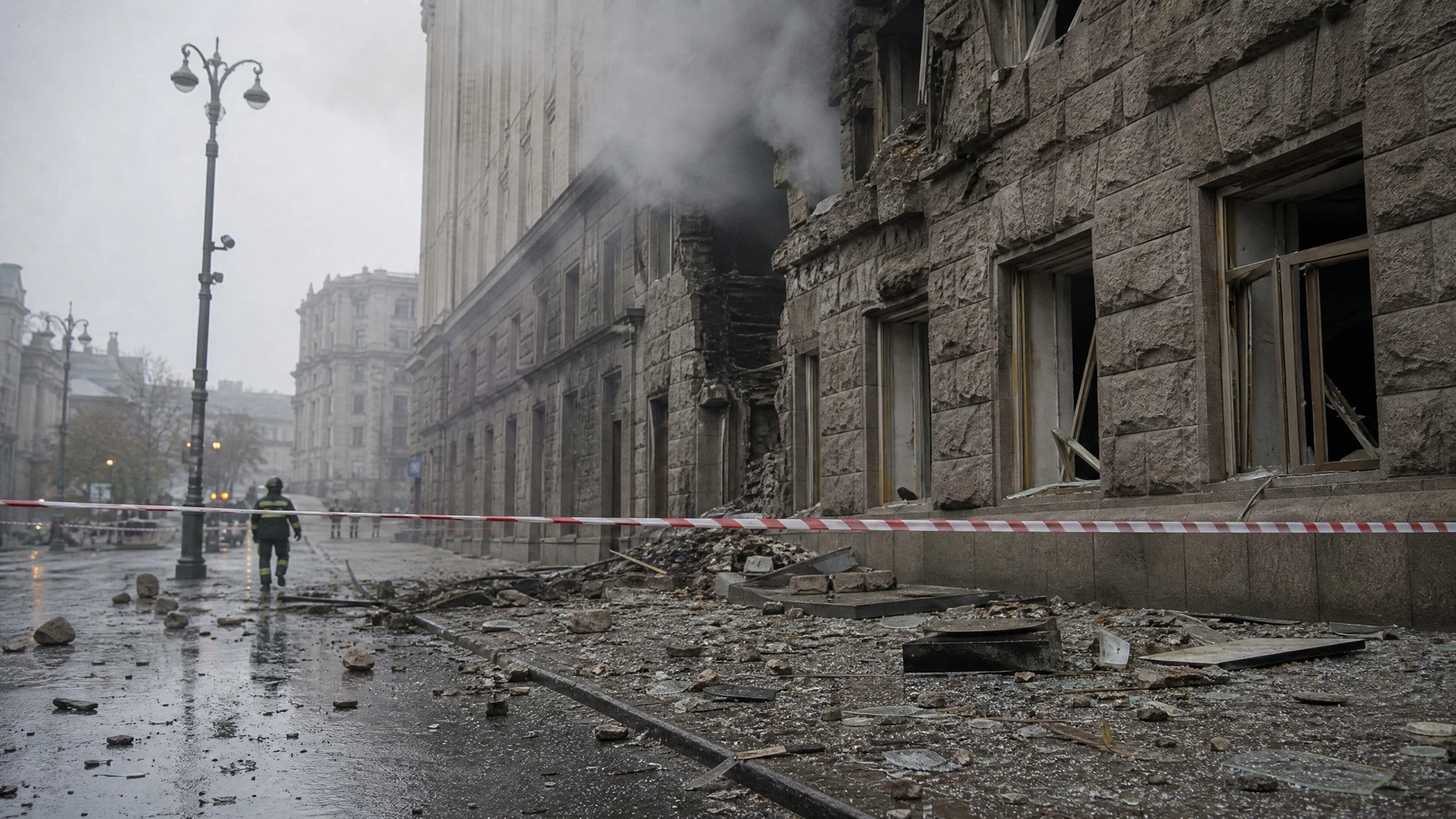
The latest verified reports reviewed for this rewrite say a Russian drone struck the headquarters of Ukraine’s Security Service, or SBU, in central Kyiv on Friday, Sept. 4, 2026. Ukrainian President Volodymyr Zelensky said the drone was aimed at the office of acting SBU chief Oleksandr Poklad; Kyiv Mayor Vitali Klitschko reported injuries. Reuters’ report, updated Sept. 5, put the number injured at at least 12, while earlier BBC and France 24 accounts cited five. [1] [2] [3]
The strike caused a fire and heavy smoke near St. Sophia Cathedral, a UNESCO World Heritage site, and damaged nearby buildings. Ukraine described the attack as a major escalation. Zelensky ordered what he called an “appropriate, tangible response,” but the latest reports reviewed here do not establish whether that response had occurred or independently confirm the munition’s type, the final casualty toll or the full extent of the damage. [1] [2] [3]
Key points
- The reported strike took place in central Kyiv on Sept. 4, 2026, and hit the SBU headquarters. [1] [2] [3]
- Zelensky said the drone was directed at the office of acting SBU chief Oleksandr Poklad; reports said Poklad was not injured. [1] [2] [3]
- Injury figures were inconsistent: Reuters reported at least 12, while BBC and France 24 reported five in earlier accounts. [1] [2] [3]
- Emergency crews worked at the site, with damage reported at nearby commercial and historic buildings. [1] [2] [3]
- Kyiv framed the incident as an escalation and said it was preparing a response; no completed retaliatory action is verified in the reviewed reports. [1] [2] [3]
What happened in central Kyiv
Reuters reported that a Russian drone hit the SBU headquarters in the historic centre during a period of sustained Russian air attacks on Kyiv. Its account described black smoke, emergency services and broken windows in a building associated with the nearby St. Sophia complex. A bakery opposite the headquarters also reported shattered glass and other damage. [1]
BBC reporting described the unmanned aerial vehicle as crashing into a room used by the SBU chief. It said images showed smoke coming from two windows and that a nearby café was damaged; one customer was taken to hospital. France 24 likewise located the strike on Volodymyrska Street, across from St. Sophia Cathedral, and reported that the site was heavily attended by ambulances and emergency workers. [2] [3]
The accounts agree on the core event and location but differ on the immediate casualty count. Reuters’ later report said the mayor put the number injured at at least 12. BBC and France 24, both published on Sept. 4, reported five. That discrepancy should be treated as an unresolved early-reporting issue rather than silently combined into a single figure. [1] [2] [3]
Verified background: the SBU’s role
The SBU is Ukraine’s domestic security and counterintelligence agency. Reuters’ background report said it emerged from the Ukrainian branch of the Soviet-era KGB after independence in 1991 and has taken on a broad wartime role, including investigating alleged war crimes, countering cyberattacks, conducting counterintelligence and pursuing suspected Russian agents. [4]
The agency also has a direct operational role in the conflict. Reuters reported that SBU Alpha special forces have conducted drone attacks against Russian military hardware, oil refineries and military facilities, while the agency has claimed responsibility for high-profile operations including the 2022 attack on the bridge to occupied Crimea and the 2025 Spiderweb drone operation against Russian strategic bombers. Those claims and Russia’s characterization of some covert operations as terrorism are part of the conflict’s competing official narratives; they do not by themselves prove the motive or legality of the Kyiv strike. [4]
Reuters’ background account said Poklad was appointed acting SBU head in July and that his office was the reported target, while the agency said he was not injured. The reported targeting therefore carried institutional significance even though the available reports do not establish whether he was present when the drone hit. [1] [4]
Why the strike matters
The headquarters is a high-profile government and security site in the centre of the capital, rather than an unidentified peripheral facility. Reuters described the incident as one of the most prominent targets struck during the war and noted that Ukrainian government buildings have rarely been damaged by drone or missile attacks. [1]
The location also raises a civilian and heritage-protection concern. The site is close to St. Sophia Cathedral, and reporting described damage to adjacent urban premises as well as the SBU building. The available accounts document the proximity and reported damage, but they do not provide a final engineering assessment or a verified valuation of losses. [1] [2] [3]
The timing added diplomatic sensitivity. Reuters and France 24 reported that US negotiators Steve Witkoff and Jared Kushner were expected to visit Moscow and Kyiv over the following days as efforts to end the war remained stalled. Zelensky proposed a reciprocal halt to airstrikes during the visits, while Foreign Minister Andrii Sybiha called the attack a rejection of diplomacy. These are Ukrainian positions, not evidence that the strike itself was intended to affect the talks. [1] [3]
What remains uncertain
First, the casualty count needs reconciliation. The later Reuters figure of at least 12 conflicts with the five reported by BBC and France 24 on the day of the attack. None of the reviewed reports supplies a final medical or city-authority tally that resolves the difference. [1] [2] [3]
Second, the reports attribute the strike to Russia, but the public evidence presented in them is primarily Ukrainian official attribution and on-the-ground reporting. The reviewed accounts do not identify a recovered munition, publish an independent forensic conclusion or report a detailed Russian explanation of the strike. The phrase “Russian drone” should therefore be understood as the reporting and official attribution in these sources, not as a separately established forensic finding. [1] [2] [3]
Third, the precise weapon model and the full structural impact were not confirmed. BBC noted that it was not known which type of munition had been used, while Reuters and France 24 described visible smoke and damage without presenting a completed building assessment. [1] [2] [3]
What happens next
The immediate next steps are likely to be factual rather than speculative: Kyiv authorities and emergency services would need to confirm the final injury total and damage, while the SBU and other investigators would establish the strike’s mechanics and assess whether operations at the headquarters were disrupted. The reviewed reports do not yet document those final findings. [1] [2] [3]
Politically, Zelensky’s order for a response and Sybiha’s call for allied pressure indicate that Kyiv intended to treat the attack as more than routine battlefield damage. Whether that produces a publicly acknowledged military action, new diplomatic measures or only further warnings is not established in the sources reviewed. [1] [3]
The most reliable updates to watch are a final Kyiv casualty statement, a documented damage assessment, any Russian defence-ministry account and independent analysis of imagery or debris.