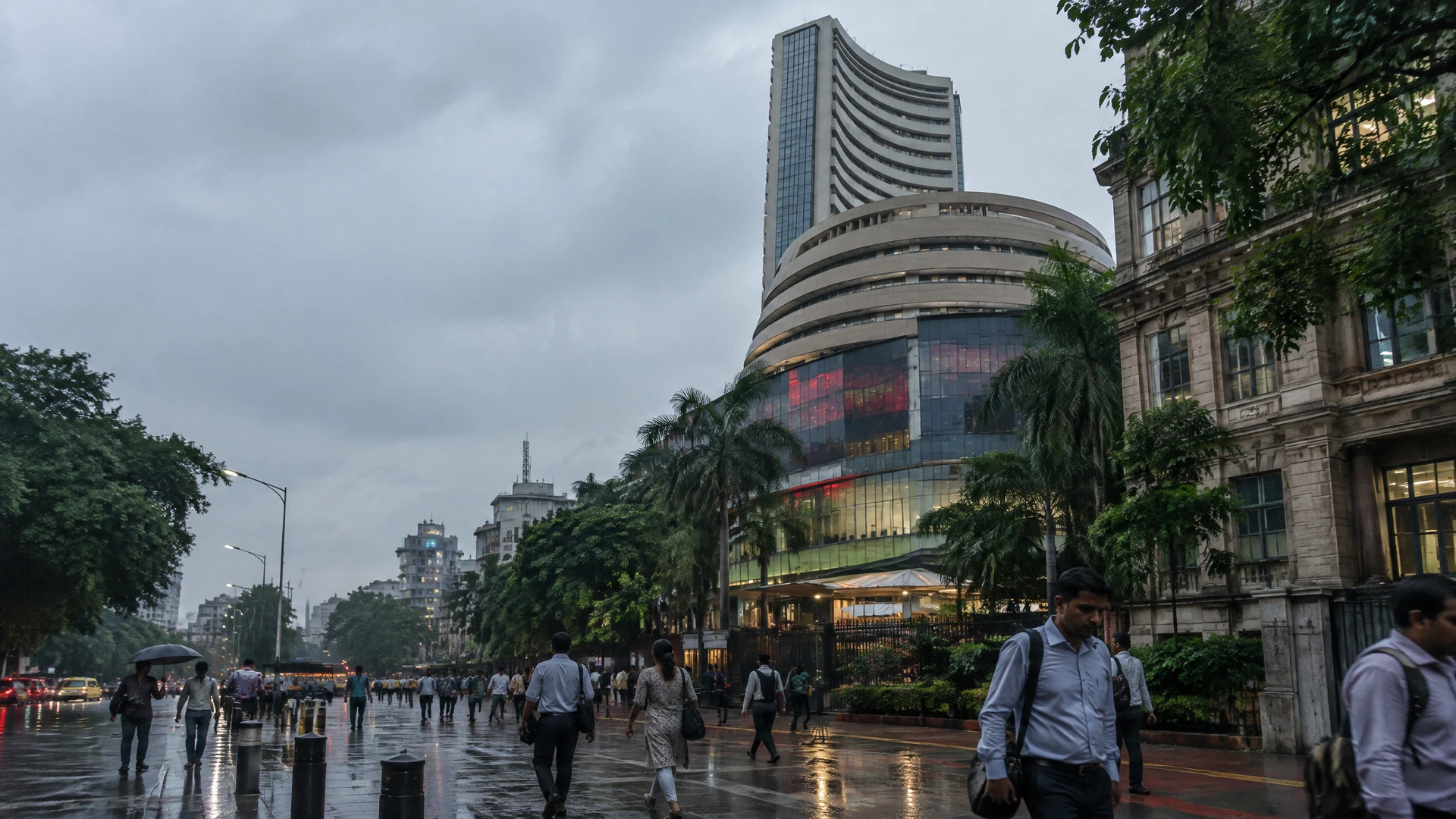
Indian equities finished lower on Friday, 11 September 2026, giving the Nifty 50 and BSE Sensex a fifth consecutive weekly loss. The Nifty fell 0.34% to 23,398.1 and the Sensex declined 0.16% to 74,781.76. Both benchmarks lost more than 2% over the week and about 4.8% across the preceding five weeks, leaving the market in a clearly risk-off state at the close.[1]
The immediate actors were investors reassessing risk as Middle East tensions pushed crude oil higher, while global bond yields reached multi-year highs. Brent crude had gained more than 8% during the week to about $104 a barrel, according to Reuters, and the rupee weakened 1%, its sharpest weekly decline since mid-May. The current status is a dated market close, not a forecast: Indian exchanges were scheduled to remain shut on Monday for a local holiday, with the next session facing the accumulated news flow.[1]
Key points
- The Nifty 50 closed at 23,398.1, down 0.34% on Friday; the Sensex ended at 74,781.76, down 0.16%.[1]
- Both headline indexes fell more than 2% in the week and roughly 4.8% over five weeks.[1]
- Fourteen of 16 major sector indexes lost ground, while small-caps fell 0.9% and mid-caps 1.4% for the week.[1]
- Brent crude rose more than 8% to about $104 a barrel as the regional conflict intensified, increasing inflation and interest-rate anxiety.[1]
- Financials lost 1.9%; information technology fell 5.8%, and the rupee dropped 1% for the week.[1]
What happened at the close
Friday’s decline was modest in percentage terms, but the weekly figures showed a broader deterioration. The 0.34% Nifty drop and 0.16% Sensex decline extended a run of five weekly losses rather than marking an isolated session. Reuters described the selling as broad-based: 14 of the 16 major sectors recorded weekly losses. That breadth matters because it shows that pressure was not confined to a single industry or a small group of large companies.[1]
The retreat also reached companies outside the benchmark’s largest names. Small-cap shares declined 0.9% during the week and mid-caps fell 1.4%. The rupee’s 1% weekly weakening added a currency dimension to the risk-off move. Reuters identified that fall as the sharpest weekly decline since mid-May, but the report did not establish how long the currency pressure would last or quantify its effect on individual companies.[1]
Verified background and context
The report links the week’s market repricing to a sequence of connected concerns. Attacks on tankers in the Strait of Hormuz intensified, while Iran-aligned Houthis threatened Saudi oil exports in the Red Sea. Brent crude futures consequently surged more than 8% during the week. These are the reported market triggers; they should not be read as proof that any one event alone determined every share-price move.[1]
Higher oil prices fed inflation fears, and those fears coincided with global bond yields rising to multi-year highs. Reuters noted the usual market transmission: higher yields can reduce the relative appeal of risk assets such as equities. The article also said investors were watching U.S. consumer-inflation data due later on Friday as a key influence on the Federal Reserve’s interest-rate decision the following week. That made an international macroeconomic release relevant to an Indian market already responding to energy and currency risks.[1]
Sector picture and company signals
Financial shares were among the clearest areas of weakness. The financial index lost 1.9% for the week. HDFC Bank fell 0.5% and extended its weekly losing streak to six weeks as uncertainty over chief-executive succession continued, while ICICI Bank dropped 3.1%. Those company-specific developments sat inside a wider pressure on financials rather than replacing it.[1]
Reliance Industries, the third-highest-weighted stock in the Nifty 50, lost 4.9% over the week. Information technology was the largest loser among major subsectors: its index declined 5.8%, the biggest weekly percentage fall since April. Reuters tied that move to expectations that the Federal Reserve could raise rates the following week, a reported investor interpretation rather than a confirmed policy decision.[1]
Why it matters for readers
The close gives readers three separate signals to track. First, the headline indexes and broader capitalization segments all weakened, indicating that the week’s stress was not limited to a narrow benchmark group. Second, oil and currency moves were moving in the same risk-sensitive direction: crude was higher and the rupee was weaker. Third, the market’s sector leadership was unsettled, with both financials and technology under pressure for different reported reasons.[1]
This combination can change how market news is interpreted without implying a trading recommendation. A lower index close alone says little about the next session. A fifth weekly loss, broad sector declines, a currency drop and a sharp energy-price move together describe the conditions investors were pricing at the reporting date. The Reuters report does not provide a return forecast, a target level or an estimate of the eventual economic cost of the oil shock, so those conclusions should remain open.[1]
What remains uncertain
The central uncertainty was duration. Ambareesh Baliga, an independent Mumbai-based market analyst quoted by Reuters, said markets could face a longer period of subdued performance unless the Middle East crisis was resolved and Brent crude eased substantially. That is an attributed assessment, not an official outlook or a verified prediction. The report did not say when the conflict would end, how much oil prices would retreat, or whether the reported threats would disrupt physical supply beyond the market reaction already recorded.[1]
The interest-rate path was also unresolved. Investors were waiting for U.S. consumer-inflation data, and the report described expectations of a possible Federal Reserve rate hike the next week. It did not report the inflation result or a final Federal Reserve decision. Consequently, the effect of those data and policy developments on Indian equities remained unknown at the close.[1]
What happens next
The next scheduled step was the Monday holiday closure. When trading resumed, investors would have to assess any new information on the Middle East, Brent crude, global yields, the rupee and the U.S. inflation-and-Federal Reserve sequence. The succession uncertainty at HDFC Bank and the separate weakness in technology shares were additional company and sector issues to monitor, but Reuters did not identify a single catalyst that would determine the next session.[1]
The most defensible reading of 11 September is therefore a status report: Indian benchmarks ended a fifth losing week amid a broad, internationally driven risk-off move. Whether that pressure persisted depended on developments that had not yet occurred or been resolved when the exchanges closed. Any later account should distinguish the confirmed closing data from the analyst view and the still-developing geopolitical and monetary-policy risks.[1]