 VERDVIT
RAF Jets Reported Close Encounters With Unidentified Drones During February Training
New October reporting describes two RAF close encounters with objects reported as possible drones during training on 18 and 23 February 2026. The objects remain unidentified, and the available evidence does not prove hostile state involvement or an attack.
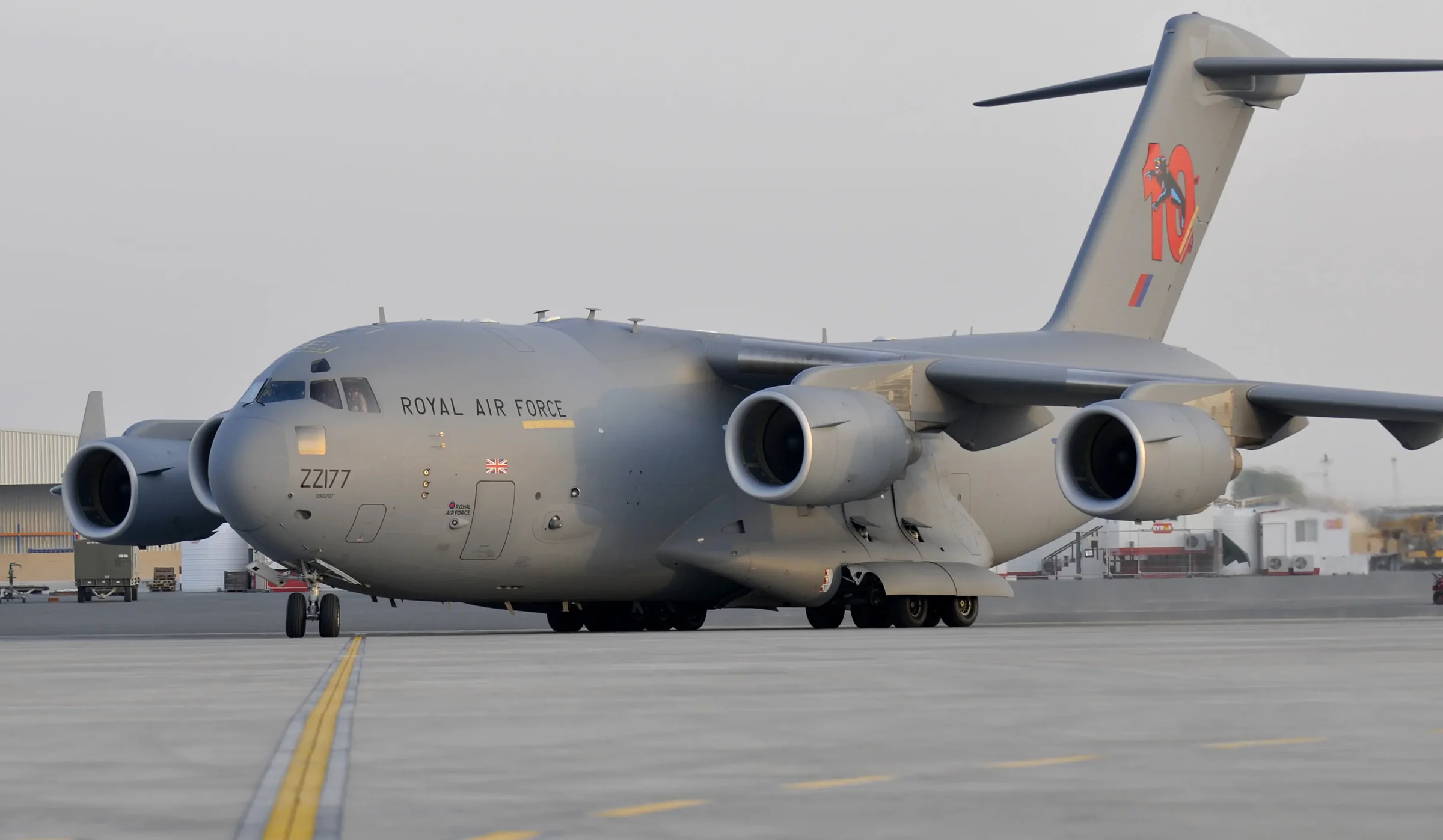
A Royal Air Force C-17 Globemaster transport aircraft at a Middle East airbase on 4 August 2011. Archive photograph; it does not show the aircraft or unidentified objects in the February 2026 reports. Credit: Sergeant Ross Tilly RAF. Open Government Licence v1.0 (OGL v1.0). Resized proportionally to a maximum 2400-pixel edge and re-encoded as WebP; full original framing preserved, with no cropping, generation, overlay or upscaling. Photo source and reuse terms.
Royal Air Force jets had close encounters with two objects described in reports as unidentified drones during training flights in February 2026, according to a report by The Daily Telegraph summarised by BBC News. The events were not a new attack on Britain: they happened months before the October reporting and remain under investigation. [1] [2]
The reported near misses took place days apart. One involved an RAF Airbus Voyager tanker during an air-to-air refuelling exercise off Cromer, Norfolk, on 18 February. The other involved a Typhoon practising simulated air combat about 30 miles off Humberside on 23 February. The objects were not identified, and there is no proof that either was controlled by a hostile state. [2] [3]
Key points - The reported encounters occurred on 18 and 23 February 2026, not in October. - One object was reported at about 17,000 feet; the second was estimated at roughly 12,500 feet. - Neither object appeared on the radar screens described in the reports. - Police and other external investigations were reported to be continuing. - The photograph in this article is a dated RAF archive image, not evidence from the incidents.
What the two February reports describe
The first incident was reported on 18 February, when a Voyager tanker was refuelling a Typhoon off Cromer. The Telegraph said an object passed directly overhead at about 17,000 feet. The tanker pilot told a military radar controller that it was small, travelling east to west and close enough to make him instinctively duck. The pilot estimated it was 100 to 150 feet above the aircraft. [2]
The report said the controller could not see the object on radar. A later account recorded that the pilot could not positively identify what he had seen as a drone and that a balloon or something similar could not be ruled out. That qualification matters: the label “drone” describes the initial report, not a confirmed identification. [2]
The second event was reported on 23 February during a Typhoon exercise involving simulated dogfights. A pilot saw what was described as a black circular object, roughly the size of a car tyre, pass above the aircraft. The object was reported at about 12,500 feet and was estimated in the records to have passed approximately 300 feet above the Typhoon. The incident was reported near Humberside, off England’s east coast. [2] [3]
Why the October report is drawing attention
The October 16 Telegraph report, and BBC’s October 17 summary, bring the February records into public view. They do not describe a fresh incursion, an attack or an emergency unfolding on 18 October. They describe earlier training incidents that were recorded by the RAF and later reported by the newspaper. [1] [2]
The timing is significant because both flights were military activities in controlled or managed airspace. The first was an air-to-air refuelling exercise and the second a simulated air-combat exercise. The reports say RAF logs recorded them as “Voyager vs drone” and “Typhoon vs drone”, while also noting that the sightings were not conclusively identified. [2]
The reported altitude also helps explain the concern. The UK Civil Aviation Authority says drones in its open category must stay below 120 metres, or 400 feet, from the closest point of the earth’s surface. The first reported object was far above that ordinary limit. However, an unusual altitude alone does not establish who operated an object or what it was. [4]
What is known about radar and investigations
A common thread in the accounts is that the objects were not visible on the radar screens described by the pilots and controllers. The absence of a radar return is a reported feature of the incidents, not proof that the objects were invisible to every sensor or that they used advanced technology. Public reporting does not provide enough information to draw that conclusion. [2]
The Telegraph said the sightings were reported to police and that “multiple different external investigations” were under way. It also reported that the RAF concluded the pilots had acted appropriately. A local investigation into the second event reportedly found no causal factors because the air-proximity incident happened off frequency and the object did not appear on radar. [2]
The Ministry of Defence did not comment on the individual incidents. In a statement quoted by The Telegraph and The Independent, it said improved detection and vigilance had increased the ability to identify, record and assess potential drone activity. The ministry said reports of drone sightings are not necessarily hostile, while credible threats can be addressed with available defence measures. [2] [3]
What the reports do not establish
The public evidence does not identify the objects, their operator or their purpose. It does not establish that they were Russian, Iranian or linked to any other government. The Telegraph discussed wider concerns about drone surveillance near Western military sites, but that broader context is not evidence connecting either February encounter to a hostile campaign. [2]
Nor does the reporting support claims of extraterrestrial craft. The descriptions concern two objects seen briefly by military aircrew during exercises. One pilot explicitly said a positive identification as a drone was impossible. Until investigators publish stronger evidence, the careful description is “unidentified objects reported as possible drones”.
That distinction is important for readers following defence and aviation stories. A near miss can justify a safety report and an investigation without proving hostile intent. It can also be serious without being an attack. The known facts are the dates, the training settings, the reported proximity and the continuing uncertainty.
What happens next
The next meaningful development would be a documented investigation finding, sensor evidence or an official identification of the objects. At present, the public record is limited to incident reports reviewed by The Telegraph, the BBC’s summary of that reporting, an independent account and the Ministry of Defence’s general statement. [1] [2] [3]
For now, the story is best understood as new reporting about two earlier RAF safety incidents. The February dates should not be replaced with October, and the word “drone” should not be turned into a claim of proven hostile action. The objects remain unidentified.
Frequently Asked Questions
Were the RAF incidents a new attack in October 2026?
No. The reported encounters took place on 18 February and 23 February 2026. The October 16–17 coverage was new reporting about those earlier events, not a report of a new attack. [1] [2]
Where did the encounters happen?
The first was reported off Cromer, Norfolk, during Voyager-to-Typhoon refuelling. The second was reported about 30 miles off Humberside during simulated air-combat training. [2] [3]
Have the objects been identified?
Not in the public reporting reviewed for this article. The accounts call them unidentified or possible drones, and one pilot said a balloon or similar object could not be ruled out. [2]
Is there proof of a hostile state or extraterrestrial origin?
No. The available reports provide no proof of either. The Ministry of Defence said drone sightings are not necessarily hostile, and the individual objects remain unidentified. [2] [3]
Related reading on Verdvit
Sources and research notes
[1] BBC News — 'Mystery drones over UK' and 'Troops heading to Poland for war games'
Source record: https://www.bbc.co.uk/news/articles/ckq5n381j7w1o. Published: 2026-10-17. Retrieved: 2026-10-18T05:48:58Z.
[2] The Daily Telegraph — RAF reports mystery drones over Britain
Source record: https://www.telegraph.co.uk/news/2026/10/16/raf-mystery-drones-britain/. Published: 2026-10-16. Retrieved: 2026-10-18T05:48:59Z.
[3] The Independent — RAF jets report ‘unidentified drones over UK’
Source record: https://www.independent.co.uk/news/uk/home-news/raf-reports-mystery-drones-uk-b3068419.html. Published: 2026-10-17. Retrieved: 2026-10-18T05:49:05Z.
[4] UK Civil Aviation Authority — Where you can fly (points 3 to 9)
Source record: https://www.caa.co.uk/drones/open-category/drone-code/where-you-can-fly-points-3-to-9/. Published: undated. Retrieved: 2026-10-18T05:49:25Z.
Reporting checked: 2026-10-18T05:49:33Z. Event date: 2026-02-18 and 2026-02-23. Source records provide attribution; navigation and citation links stay on Verdvit.
Article information
Title: RAF Jets Reported Close Encounters With Unidentified Drones During February Training
Description: The Telegraph reported two February 2026 RAF near misses over the North Sea and east-coast training areas. The objects remain unidentified.
Topics: RAF, unidentified drones, United Kingdom, North Sea, defence