A September 8 gathering beside Amazon’s planned data centre in Thane has put a local infrastructure dispute back in the spotlight. Residents want the project moved away from homes, while Amazon says the facility has been designed to avoid drawing potable water for cooling or electricity from the local distribution network. A Reuters report published on October 8 and updated on October 9 documented the protest, interviews with residents and visits to the site. [1]
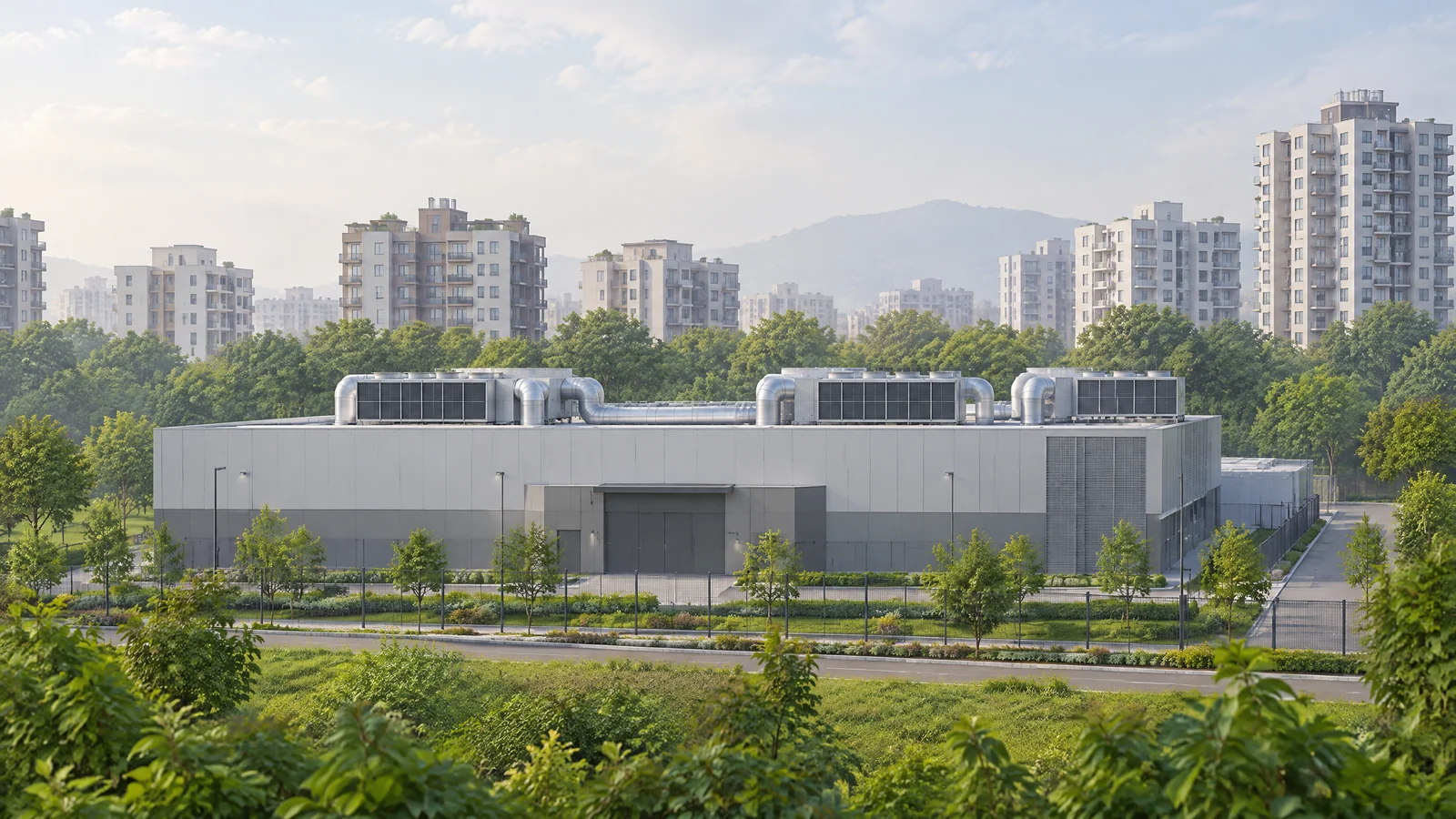
The dispute is centred on the proposed hyperscale facility at Balkum, near Majiwada and Dhokali. The project has been described in public reporting as covering roughly 53 to 58 acres. The disagreement is not simply about whether Thane should host a data centre. It is about where a very large facility should be built, how its utilities will be supplied, and whether residents have received enough information about its effects.
Key points
- Hundreds of residents gathered near the site on September 8 and called for the project to be relocated, according to Reuters. [1]
- Residents have raised concerns about water, electricity, heat, noise, tree removal and the facility’s proximity to homes, schools and hospitals. [3] [4]
- Amazon says it will use closed-loop cooling, with no water used for cooling, and reports total planned water use of 125 kilolitres per day. [2]
- Publicly reported water figures differ: an older permit figure was 0.01 million litres per day, while a Thane civic official was reported as referring to 12 million litres of treated sewage water. [2] [3]
- Amazon says the site will use a dedicated high-voltage connection rather than the local distribution network serving homes and shops. [1] [2]
What happened
The latest documented protest took place on September 8, when residents gathered beside the project site holding placards and asking that the facility be moved. Reuters reported that more than 1,000 people living near the site said the project had advanced without meaningful consultation. The same report said residents were worried about strain on power and water supplies and about noise near a residential area. [1]
That gathering followed protests in July. The Federal, carrying a PTI report, said several hundred people demonstrated in Balkum on July 18. Residents from Balkum, Kolshet and Dhokali cited environmental concerns, noise, water use and electricity demand. The report said a delegation had met the Thane municipal commissioner and Amazon representatives, but protesters considered the outcome unsatisfactory. [5]
Frontline reported that the group Wake Up Thanekar had held a human-chain protest at the site on July 18. It described the project as a 53-acre purchase by Amazon from Kalpataru Builders and said residents pointed to nearby schools, hospitals and housing complexes. The report also said Thane MP Naresh Mhaske had asked for the project to be shifted. [4]
Why it matters
A hyperscale data centre is not a normal office or a conventional call centre. It requires large amounts of computing equipment, cooling infrastructure and backup power. That makes location and utility planning important in a dense neighbourhood, even when a company says the facility will be connected through dedicated infrastructure.
Residents’ concerns have focused on four linked questions. First is water: whether the project’s final demand will affect a city that residents describe as already facing shortages. Second is electricity: whether a large, uninterrupted load could affect other consumers during supply stress. Third is heat and noise from cooling systems, generators and other equipment. Fourth is land-use and consultation, including the project’s proximity to schools, hospitals and high-rise housing.
These concerns are not proof that the facility will cause a temperature rise, an outage or health harm. The available reporting records them as resident objections and predictions. The distinction matters because the project is still being built, and no retrieved source establishes that it has already produced those impacts.
What Amazon says
Amazon’s own facts page says the Thane facility will use closed-loop cooling. In that system, the company says, a fixed volume of coolant circulates through sealed pipes, so water is not consumed for cooling and wastewater is not discharged from that process. Amazon says its total planned water use is 125 kilolitres per day: 10 KLD for employee drinking water and restrooms, and 115 KLD of treated sewage water for landscaping and irrigation. [2]
That explanation is more detailed than the 0.01 million litres per day figure cited in earlier reporting as the approved water supply permit. Hindustan Times also reported a Thane civic official’s statement that 12 million litres per day of treated sewage water would be supplied for the facility. These figures may refer to different stages, uses or assumptions, but the retrieved sources do not independently reconcile them. [2] [3]
On power, Amazon says the data centre will use an industrial connection to the high-voltage transmission grid and a dedicated substation planned with the utility. It says the facility will not draw or divert electricity from the local distribution network serving residential and commercial consumers. Amazon also says it will comply with the Noise Pollution (Regulation and Control) Rules, 2000, and use sound-dampening materials, acoustic enclosures and mufflers where required. [2]
The company rejects the suggestion that heat from the servers will raise temperatures in nearby communities. Its position is that air-handling systems will distribute heat efficiently and that it will dissipate into the atmosphere. Amazon also says generators will generally run only for brief daytime tests except during rare emergencies. [2]
What remains uncertain
The public record does not yet answer how the competing water figures were produced, which approvals govern each use, or whether the final operating design differs from earlier submissions. It also does not independently verify the facility’s eventual power demand, noise levels or local thermal effect.
The project’s footprint is variously reported as 53, 53–58 or 54 acres. That variation is small enough to describe the site as roughly 53 acres, but estimates should not be presented as audited measurements. Claims about protesters, nearby populations and future resource pressure also need attribution.
Amazon says its environmental-clearance documents are publicly available through the government’s PARIVESH portal. A full editorial review should inspect those primary documents before publication if the article is to make detailed claims about permissions, tree work, sewage supply or compliance. [2]
What happens next
The immediate next step is clearer disclosure and engagement rather than a confirmed change in the project’s legal status. Residents are seeking answers on approvals, utility connections, emergency preparedness, safeguards and water requirements. Reuters reported that Amazon was considering community-outreach plans, although that does not amount to a relocation decision. [1]
Thane’s civic authorities and the company would need to explain the water figures in one consistent, publicly checkable account. Any future reporting should also verify whether the dedicated power connection has been commissioned, whether construction milestones have changed, and whether a public hearing, review committee or other official process has produced a decision.
For now, the defensible account is narrower than some protest claims: residents have mounted opposition, the September 8 protest is documented, Amazon has published detailed assurances, and the most important resource questions remain contested. The facility’s eventual effects cannot be treated as established before independent measurements and official records show them.