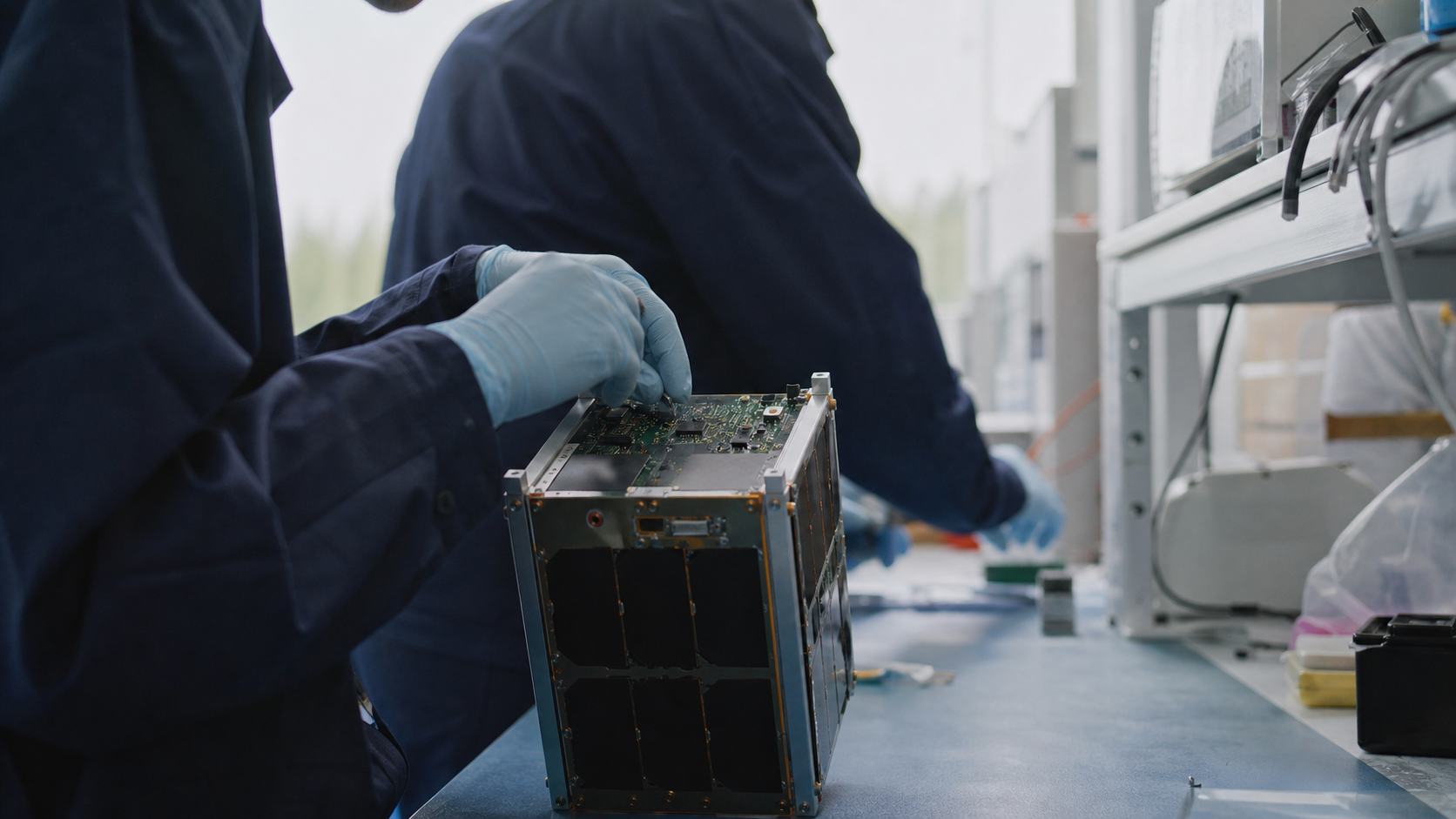
Reuters reported on 24 September 2026 that Google plans to send a prototype carrying Tensor Processing Units (TPUs) into low Earth orbit on SpaceX's Transporter-18 rideshare, in partnership with Planet. The planned mission is an early engineering experiment: it is intended to collect in-orbit data on whether the chips and hardware can survive launch and operate in space, not to deploy a commercial data centre. [1] Google described the launch as a first step toward learning what works and what future missions must change. [2]
The test matters because it moves Project Suncatcher from a published system concept toward hardware operating in the real environment. Google's stated scope covers launch vibration, radiation exposure and thermal behaviour in a vacuum; a later milestone is expected to test laser links between two satellites. The evidence does not establish a launch, useful production workload in orbit or a ready orbital computing business. [1] [2]
Key points
- The planned payload is a prototype TPU-equipped satellite, not an operational orbital data centre. [1] [2]
- Transporter-18 is the intended SpaceX rideshare, with Planet identified as Google's partner for the learning mission. [1] [2]
- The first test is designed to measure launch stresses, radiation effects and cooling in vacuum. [1] [2]
- Google has described high-bandwidth laser interconnection as a later test, involving two satellites targeted for 2027. [1] [2]
- Commercial viability remains unproven because networking, thermal management, reliability, launch economics and ground links still require validation. [2] [3]
What Google is testing
The immediate question is hardware survival. A rocket launch subjects spacecraft to sustained acceleration and intense vibration, while low Earth orbit exposes electronics to radiation that can cause transient errors or permanent damage. Google says its engineers shook the satellite along all three axes to reproduce launch frequencies. The company's account says the rocket journey to orbit lasts about 10 minutes, spacecraft loads can reach up to 10 times the force of gravity, and individual components can experience higher local forces. Those figures describe the test basis, not an orbital result. [2]
Radiation is a separate failure mode. Google reports that it ran Trillium TPUs through a 67MeV proton-beam test at UC Davis's Crocker Nuclear Laboratory while workloads were running. The company says early testing found the chips could tolerate more radiation than expected during a shielded five-year mission, while monitoring bit flips. These are pre-launch laboratory results supplied by Google; they do not substitute for measurements during an actual orbit, where radiation conditions, shielding, software behaviour and mission duration interact. [2] [3]
Why cooling is difficult in orbit
AI accelerators turn electrical power into heat. On Earth, data centres move that heat with air or liquid systems before rejecting it through plant-scale equipment. In vacuum, there is no surrounding air to carry heat away by convection. A spacecraft must conduct heat from the chips to radiators and then emit it to space, while controlling temperatures across changing sunlight and eclipse conditions. [2]
Google says the prototype uses a combination of heat pipes and radiators and that the design has been exercised in a thermal-vacuum chamber. The orbital test is therefore a validation step for a particular cooling approach, not proof that future constellations can dissipate the much larger heat load of a dense AI installation. The result will need to show not only that the chips remain within safe temperatures, but also that cooling performance is compatible with power generation, mass, pointing and spacecraft reliability. [2]
The communications problem comes later
A single satellite carrying TPUs would not by itself reproduce the tightly connected architecture of a terrestrial AI cluster. Google's longer-term concept uses multiple solar-powered satellites linked by free-space optical communications. The company says future systems would need very high-bandwidth, low-latency connections so workloads could be distributed across accelerators in orbit. Its earlier design work discusses links in the tens-of-terabits-per-second range and says a bench demonstrator reached 800 gigabits per second in each direction, but those are design and laboratory claims rather than results from a deployed constellation. [3]
The first orbital mission is not the announced end-to-end networking demonstration. Google says it plans to test its optical inter-satellite link work with two satellites in 2027. Pointing narrow laser beams between fast-moving spacecraft requires precise knowledge of position and attitude, stable formation flying and dependable acquisition and tracking. The two-satellite test could provide evidence about that link layer; it would still fall short of proving a large, continuously operating AI cluster. [2]
What the broader concept proposes
Google's November 2025 research description proposes compact constellations in a dawn-dusk, sun-synchronous low Earth orbit, where satellites could receive near-continuous sunlight and reduce dependence on heavy batteries. The company has argued that solar panels in a suitable orbit could produce up to eight times more power than on Earth, but that figure is an architectural premise, not a guarantee for a complete spacecraft after accounting for orientation, degradation, conversion losses, communications and thermal systems. [3]
The same research identifies orbital dynamics, radiation, high-bandwidth communications, thermal management and reliability as unresolved engineering challenges. It presents a modular constellation as a possible route to scale and explores whether launch prices could eventually make the concept economically comparable with terrestrial infrastructure. Those are forward-looking analyses and modelled scenarios. They should not be read as a committed Google deployment schedule or as evidence that the economics have been demonstrated. [3]
What remains uncertain
The status of the Transporter-18 test is central. Reuters and Google describe a planned or upcoming mission, so the public record reviewed for this article does not establish a completed launch, successful orbital operation or a final data set. [1] [2] It is also not clear from the cited material how long the payload will operate, which workloads will be executed, how much shielding and power the flight unit carries, or what thresholds would count as success. Those details matter when distinguishing a surviving chip from a useful computing system.
Several larger claims remain outside the test's scope. One mission cannot establish multi-satellite reliability, servicing, debris resilience, regulatory readiness, secure ground connectivity or an acceptable cost per unit of compute. It also cannot show that orbital systems outperform terrestrial data centres after launch, replacement, telemetry and communications costs are included. Google's own description calls Project Suncatcher a moonshot and says significant engineering hurdles remain. [2] [3]
What happens next
The next verifiable milestones are operational rather than promotional: confirmation of launch, telemetry from the prototype, published measurements of radiation and thermal performance, and an account of any failures or mitigations. A later two-satellite optical-link demonstration would address a different question—whether spacecraft can exchange data precisely and quickly enough for distributed workloads. [2]
Only after those tests, and further work on power, cooling, formation control, ground links, manufacturing and launch cost, could the concept be assessed as infrastructure rather than research. For now, Project Suncatcher is best understood as a measured attempt to obtain missing orbital data. Its significance lies in testing specific engineering assumptions; its limits are equally important because no reported result yet proves a commercially viable data centre in space.