 VERDVIT
Shadab Khan's Unbeaten 113 Rescues Pakistan in England Thriller
Shadab Khan’s unbeaten 113 and an 89-run last-wicket stand with Haris Rauf rescue Pakistan against England and secure a tri-series final place.
Pakistan were nine wickets down when Shadab Khan turned a collapsing chase into a remarkable one-wicket victory over England. His unbeaten 113 and an 89-run final-wicket partnership with Haris Rauf carried the hosts home in Lahore on 25 October 2026, securing a place in the ODI tri-series final.
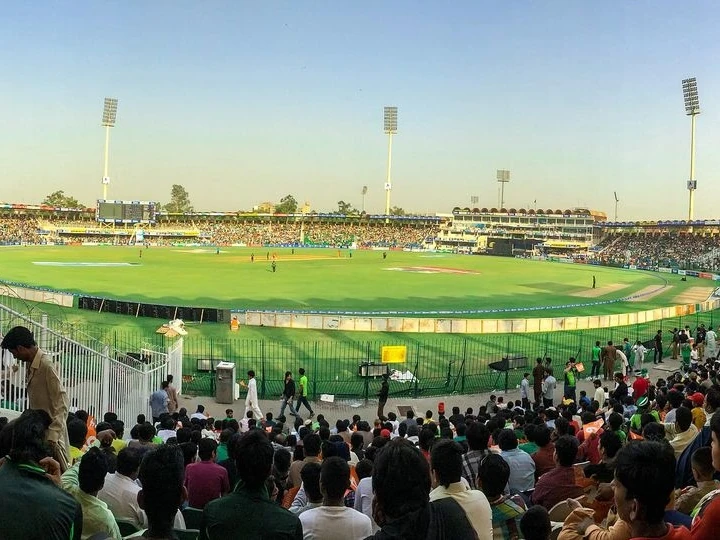
Gaddafi Stadium, Lahore: real archive photograph by Younisjunejo from2015, using the Commons crop by M.Billoo2000. Not a photograph of Shadab's innings or the25October2026 finish. CC BY-SA 4.0.
England had been bowled out for 241, but Pakistan's position at 154/9 made the target of 242 look distant. The match changed because Shadab kept scoring and Rauf stayed with him long enough for the last pair to finish the job with 17 balls remaining.
Key Takeaways - England made 241 all out in 46.4 overs, with Ben Duckett scoring 105. - Pakistan recovered from 154/9 through Shadab's unbeaten 113 and the last pair's 89-run stand. - Haris Rauf finished unbeaten on seven and partnered Shadab through the winning phase. - Pakistan won by one wicket and qualified for the tri-series final; the result did not itself award the tournament trophy.
A completed ODI result, not an unfinished score update
The match was played at Gaddafi Stadium in Lahore. Reuters' dated report and Sky Sports' completed account agree on the central outcome: Pakistan beat England by one wicket after Shadab's century rescued a chase that had reached its final partnership. This page records that completed match, not an early innings projection.
The format explains the two different measures of the victory. One wicket describes how close Pakistan were to losing their last batting partnership. Seventeen balls remaining describes the amount of scheduled batting time left when the target was reached. A side can be close to defeat through wickets even while there is still time to score the required runs.
That distinction helps explain why this finish was more unusual than an ordinary late chase. Pakistan were not merely accelerating with several batters left. They were asking one established scorer and the final batting partner to complete everything still required, with no further partnership available if a wicket fell.
Duckett’s hundred kept England’s innings together
Ben Duckett scored 105 in England's 241. His century was the largest individual contribution in the visitors' innings and gave England something substantial to defend after Pakistan's bowlers created early difficulties. A completed hundred can be important to an innings even when the eventual match result goes against the batter's team.
Reuters describes England losing early wickets before Duckett and Sam Curran steadied the innings with a fifth-wicket partnership. Curran made 42. Later contributions helped England move beyond 200, but the innings ended in 46.4 overs rather than using the full allocation of 50.
Being bowled out early is part of the explanation of the target, though it should not be converted into an invented forecast of what England would otherwise have scored. The confirmed total was 241. Pakistan needed 242 to win, and the rest of the match must be understood against that actual requirement.
Shaheen’s wickets gave Pakistan the first opening
Shaheen Shah Afridi finished with 4/46. His work with the ball put Pakistan in a position to chase a total that was below what an uninterrupted England innings might have threatened, although no hypothetical alternative score is needed to value the four wickets he actually took.
The Reuters report records Afridi dismissing Tom Banton and Joe Root early, with further damage leaving England under pressure. Duckett's recovery therefore happened in an innings that had already required repair. The contest did not begin with Pakistan's late comeback; both innings contained a phase in which the batting side had to rebuild.
For a reader assessing the result, this is why Shadab's century should not erase the bowling effort. The target existed at its final level because Pakistan had first taken ten wickets. The chase then needed a separate rescue when the batting side lost control of its own innings.
Pakistan’s chase reached the final partnership
Pakistan's position at 154/9 was the turning point recorded by both Reuters and Sky Sports. At that stage, England needed only one more wicket, while Pakistan still had a substantial distance to cover. Ordinary batting depth was no longer an option because the side had reached its last pair.
Earlier contributions had not produced a stable chase. Reuters records Fakhar Zaman and Babar Azam making ten apiece, with Saad Baig and Salman Ali Agha providing a partial recovery. Shadab came in with Pakistan already struggling and eventually became the player around whom the remaining chase had to be organised.
The significance of the last-wicket stand lies in its uninterrupted nature. After the ninth wicket, every further scoring passage had to be completed without the next dismissal. That makes the partnership's survival as important as the boundaries and singles recorded during it.
Shadab’s century changed the direction of the match
Shadab finished unbeaten on 113. This was not a century made after the outcome was comfortable: it was the innings that brought Pakistan back from their final wicket to a winning position. The final score is a stronger foundation for the report than unsupported descriptions of every shot or assumptions about the bowlers' intentions.
The published accounts describe a counter-attack, but their boundary breakdowns differ. This report does not choose a convenient count and present it as certain. The mutually supported facts are the unbeaten century, the 89-run partnership and the completed one-wicket victory. Those are sufficient to explain the scale of the comeback.
Reuters also reports that Shadab successfully reviewed an lbw decision during the closing phase. The reversal mattered because the final wicket would have ended the chase. The exact runs-needed figure around that incident is not repeated here because the accounts vary on that detail.
Rauf’s seven runs had a larger role than their size suggests
Rauf finished on seven not out from 19 balls. His individual score was much smaller than Shadab's, but the pair could not have completed their partnership without both batters remaining available. In a final-wicket chase, occupying the crease is itself a contribution to the result.
Sky Sports' account records Rauf striking the winning boundary. The finish is a reminder that a partnership total does not belong to one player alone, even when one batter supplies most of the runs. Shadab's scoring and Rauf's survival were connected parts of the same winning phase.
This is explanatory match analysis, not a claim about private tactical conversations or dressing-room instructions. The available reports show what the pair achieved. They do not establish every decision made between deliveries, and this article does not invent those exchanges.
The tournament consequence and the limits of the result
Reuters reports that the victory secured Pakistan's place in the tri-series final and left England with a third successive defeat in the competition. Qualification is the immediate confirmed consequence. It is different from winning the final, and no later tournament result is implied by this report.
The Lahore match combined Duckett's century, Afridi's four wickets and a last-pair rescue that changed the outcome after England had come close to completing the chase's collapse. It is best remembered through that sequence rather than through a single exaggerated description. For other dated results and explainers, browse Verdvit's latest articles; each new match must be checked against its own completed record.
Reporting and image notes
Verified completed event record
Reuters’ 25 October report and the complete Sky Sports account were opened. They support England 241 all out in 46.4 overs, Duckett 105, Shaheen 4/46, Pakistan 154/9, Shadab 113 not out, an 89-run last-wicket stand with Rauf and a one-wicket win with 17 balls remaining. Pakistan qualified for the tri-series final. Exact source URLs are retained in Verdvit’s private editorial record.
Reporting and analysis limits
Reuters supports the early wickets and the successful late lbw review; Sky records Rauf’s unbeaten seven from 19 balls and winning boundary. Conflicting boundary counts and exact DRS runs-needed figures are deliberately excluded. Partnership and chasing explanations are analysis, not invented dressing-room exchanges or a tournament-title prediction. Exact source URLs are retained in Verdvit’s private editorial record.
Image attribution
Gaddafi Stadium, Lahore: real archive photograph by Younisjunejo from2015, using the Commons crop by M.Billoo2000. Not a photograph of Shadab's innings or the25October2026 finish. CC BY-SA 4.0. Original source and licence are retained in the provenance record. Verdvit proportionately re-encoded this photograph to WebP without a crop or added content. No current event, product identity or endorsement is implied.