 VERDVIT
Kimi Antonelli Wins in Austin as F1 Title Wait Continues
Kimi Antonelli wins the United States Grand Prix ahead of Charles Leclerc and Max Verstappen after an effective one-stop race; the F1 title remains undecided.
Kimi Antonelli won the United States Grand Prix with a controlled one-stop race, finishing ahead of Charles Leclerc and Max Verstappen in Austin. The Mercedes driver's victory on 25 October 2026 strengthened his championship campaign, but it did not secure the Drivers' Championship at this event.
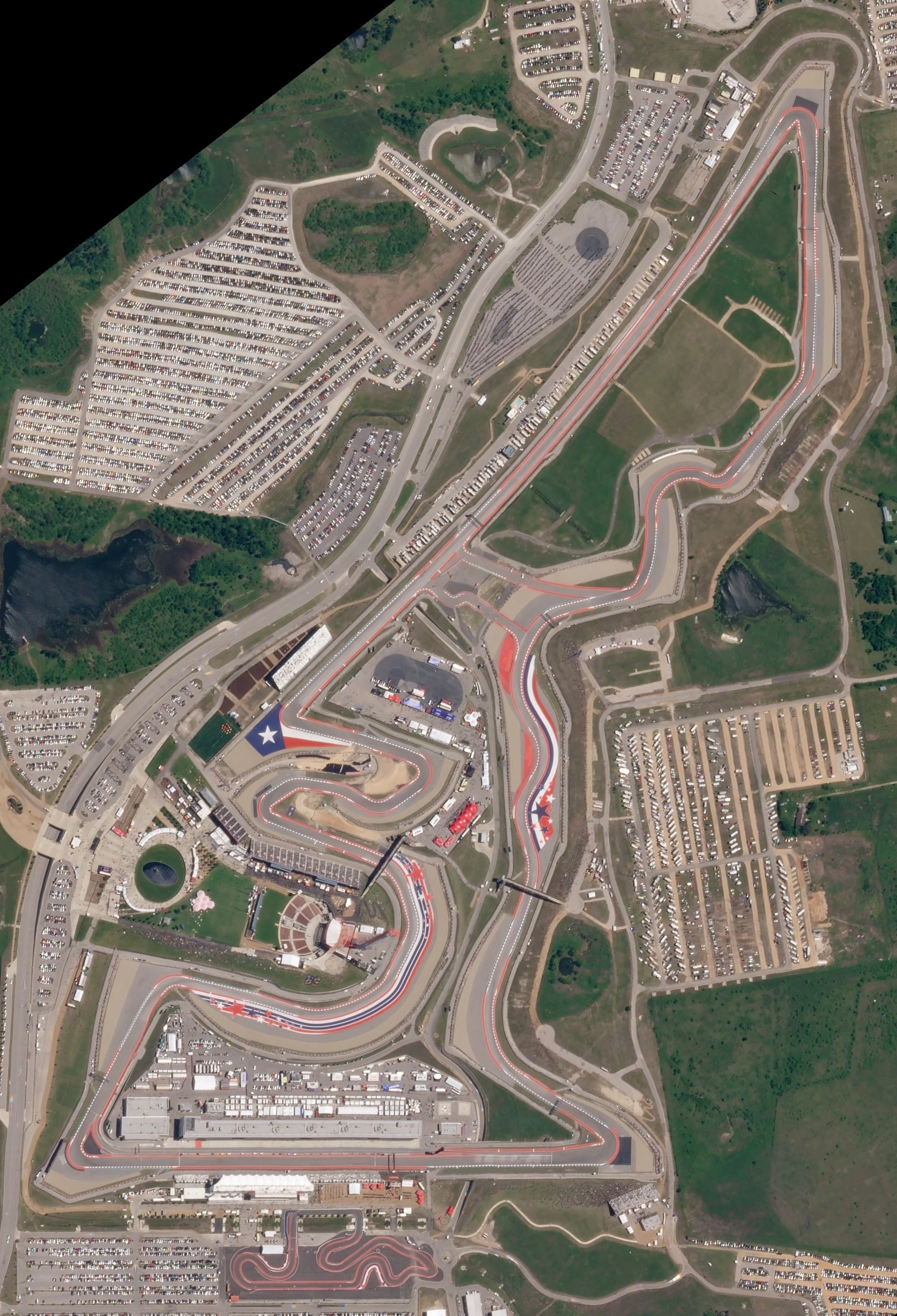
Circuit of the Americas, captured by a Planet Labs SkySat satellite on 22 April 2018; Commons crop/rotation by Ahecht. Real archive venue image, not a photograph of Antonelli, the 2026 race or its podium. CC BY-SA 4.0.
Formula1's official race report records Antonelli's ninth Grand Prix victory of the season and a 13.078-second advantage over Leclerc. The central story was how an extended opening stint and a successful switch from medium to hard tyres allowed him to stay ahead of rivals who followed different pit-stop plans.
Key Takeaways - Antonelli won the 56-lap United States Grand Prix at the Circuit of the Americas. - Leclerc finished second, Verstappen third, Lewis Hamilton fourth and Lando Norris fifth. - Antonelli used a one-stop medium-to-hard strategy, making his change at the end of lap 24. - The race win and the championship title were separate outcomes: the title remained undecided after Austin.
The official result at Circuit of the Americas
Formula1's completed report gives Antonelli's winning time as 1:35:16.650. Leclerc finished 13.078 seconds behind, while Verstappen was 17.485 seconds behind the winner. Hamilton followed in fourth, with Norris completing the top five. These are the published race-result figures, not predictions based on practice or qualifying.
The 56-lap Grand Prix is the event covered by this article. A qualifying position, a practice session or another weekend result should not be substituted for the Sunday race classification. Keeping those sessions separate is particularly useful when the same drivers appear across several trending headlines during one event weekend.
The venue photograph accompanying this page is also dated separately. It is a real satellite archive view of Circuit of the Americas, not a photograph of Antonelli's winning lap, the 2026 podium or that day's crowd. Its role is to help readers recognise the location without suggesting it documents the race action described here.
The start gave Antonelli room to build his race
The official report describes Antonelli holding the lead at the start while Verstappen briefly fell into the contest with Ferrari's drivers. Leclerc moved ahead before Verstappen recovered second during the opening lap. That sequence allowed Antonelli to begin building space at the front rather than immediately fighting for position.
An early lead does not automatically decide a Grand Prix, because pit stops, traffic, tyre performance and interruptions can change the order. In this case, however, the lead provided a platform for Mercedes to run its opening stint longer. The important point is not simply that Antonelli started well, but that the race continued to support the plan built around that position.
This description follows the official event report rather than private team information. It does not assign an unverified technical cause to every start or assume that a driver had a particular failure unless the published report establishes it. The race order and the broad sequence are the reliable starting points.
Why the one-stop plan mattered
Antonelli started on medium tyres and changed to the hard compound at the end of lap 24. Formula1's account presents that extended first stint as central to his victory. Several rivals stopped twice, creating a strategic contrast between preserving track time and using fresher tyres over shorter runs.
A one-stop race saves the time associated with making an additional pit visit, but it also asks the tyres to remain competitive for longer. That trade-off is the explanatory principle behind the strategy, not evidence that fewer stops are always faster. The correct plan depends on the particular race, the car and what is happening around it.
Austin's result shows that Antonelli made the one-stop approach work on this occasion. It does not prove that every driver could have achieved the same result by copying the plan, or that the same approach will be best at the next circuit. Those claims would require evidence beyond the completed race report.
Leclerc turned the late battle into second place
Leclerc finished second after a late move improved his position. The official report identifies it as a second consecutive P2 finish and records Hamilton adding another substantial Ferrari result in fourth. Ferrari therefore had two drivers in the leading four, even though neither could catch Antonelli for the victory.
For the reader, it helps to distinguish the contest for the win from the contest for the remaining podium places. A race can become clear at the front while still changing behind the leader. Leclerc's result is part of that second contest and should not be reduced to a static position that never changed during the afternoon.
His 13.078-second finishing gap is the official end-of-race comparison. It is not a constant gap maintained on every lap, and it should not be used to invent a precise performance advantage at any earlier moment. A final classification captures the outcome, while the race narrative explains how the drivers arrived there.
Verstappen completed the podium despite difficulties
Verstappen finished third, with Formula1's report describing issues affecting his Red Bull during the race. The same account records his attempts to challenge Antonelli before the differing stop sequences and later battles settled into the final order. Third place therefore reflects both the pace shown and the obstacles described in the official reporting.
This page does not turn those reported difficulties into a complete diagnosis of the car. Public race coverage is not a substitute for engineering data, and words used over team radio do not establish every underlying component problem. The supported statement is that Verstappen completed the podium after a race in which the official account reported handling and other difficulties.
Norris finished fifth after his late opportunity to challenge for a podium faded with ageing tyres, according to the same report. His result provides another example of why tyre life remained part of the contest beyond the first pit stops. Strategy was not only about when to stop, but also about what performance remained afterwards.
A late Virtual Safety Car did not change the winner
The official report records a late Virtual Safety Car after Valtteri Bottas stopped beside the track. A Virtual Safety Car slows the field under a controlled procedure; it is not the same thing as every car gathering behind a physical Safety Car. That distinction matters when considering how an interruption might affect a leader's advantage.
Antonelli still finished with the recorded 13.078-second margin. The interruption belongs in the race narrative because it changed the conditions under which the closing laps were completed, but it did not turn the result into an unresolved contest or remove the win from the official classification.
There is no need to reconstruct unreported alternative outcomes. What would have happened without the interruption is hypothetical. The result that can be documented is the one achieved under the actual race conditions, with Antonelli ahead of Leclerc and Verstappen at the finish.
Winning in Austin was not the same as clinching the title
Formula1's headline and race account explicitly state that Antonelli did not secure the Drivers' Championship in Austin. His ninth Grand Prix victory of the season was a major result, but the title remained a separate question requiring the relevant championship conditions to be met.
This article deliberately does not publish an unchecked points gap or promise that the championship will be won at the next race. A championship calculation should use the current official standings and the points still available, not just the winner of one event. That is a useful distinction for anyone following F1 through short result headlines.
The takeaway from Austin is a documented race win built around a strong start and an effective one-stop strategy, with Ferrari and Red Bull completing the podium. Follow Verdvit's latest articles for other dated reports and explainers. This page remains an account of the completed United States Grand Prix, not a live timing feed, betting recommendation or forecast of the final championship outcome.
Reporting and image notes
Verified completed event record
Formula1’s primary completed United States Grand Prix report and result page were opened, including the full report in My Browser. They support Antonelli’s win, 56 laps, 1:35:16.650 race time, Leclerc +13.078 seconds, Verstappen +17.485 seconds, Hamilton fourth and Norris fifth. The title was not clinched in Austin. Exact source URLs are retained in Verdvit’s private editorial record.
Reporting and analysis limits
The official race report supports the medium-to-hard one-stop plan and lap-24 stop, ninth Grand Prix win of the season, start sequence, late Ferrari battle, reported Red Bull difficulties and Bottas-related late Virtual Safety Car. Strategy explanation is labelled analysis, not private telemetry. No unverified championship points gap, ticket/betting promotion or guaranteed next-race title. Exact source URLs are retained in Verdvit’s private editorial record.
Image attribution
Circuit of the Americas, captured by a Planet Labs SkySat satellite on 22 April 2018; Commons crop/rotation by Ahecht. Real archive venue image, not a photograph of Antonelli, the 2026 race or its podium. CC BY-SA 4.0. Original source and licence are retained in the provenance record. Verdvit proportionately re-encoded this photograph to WebP without a crop or added content. No current event, product identity or endorsement is implied.