 VERDVIT
France Protests on 17 October: Clashes, Fires and More Than 1,200 Arrests
A sourced account of France’s 17 October 2026 demonstrations, the changing arrest and turnout figures, school and cost-of-living grievances, and the distinction between peaceful marches and violence.
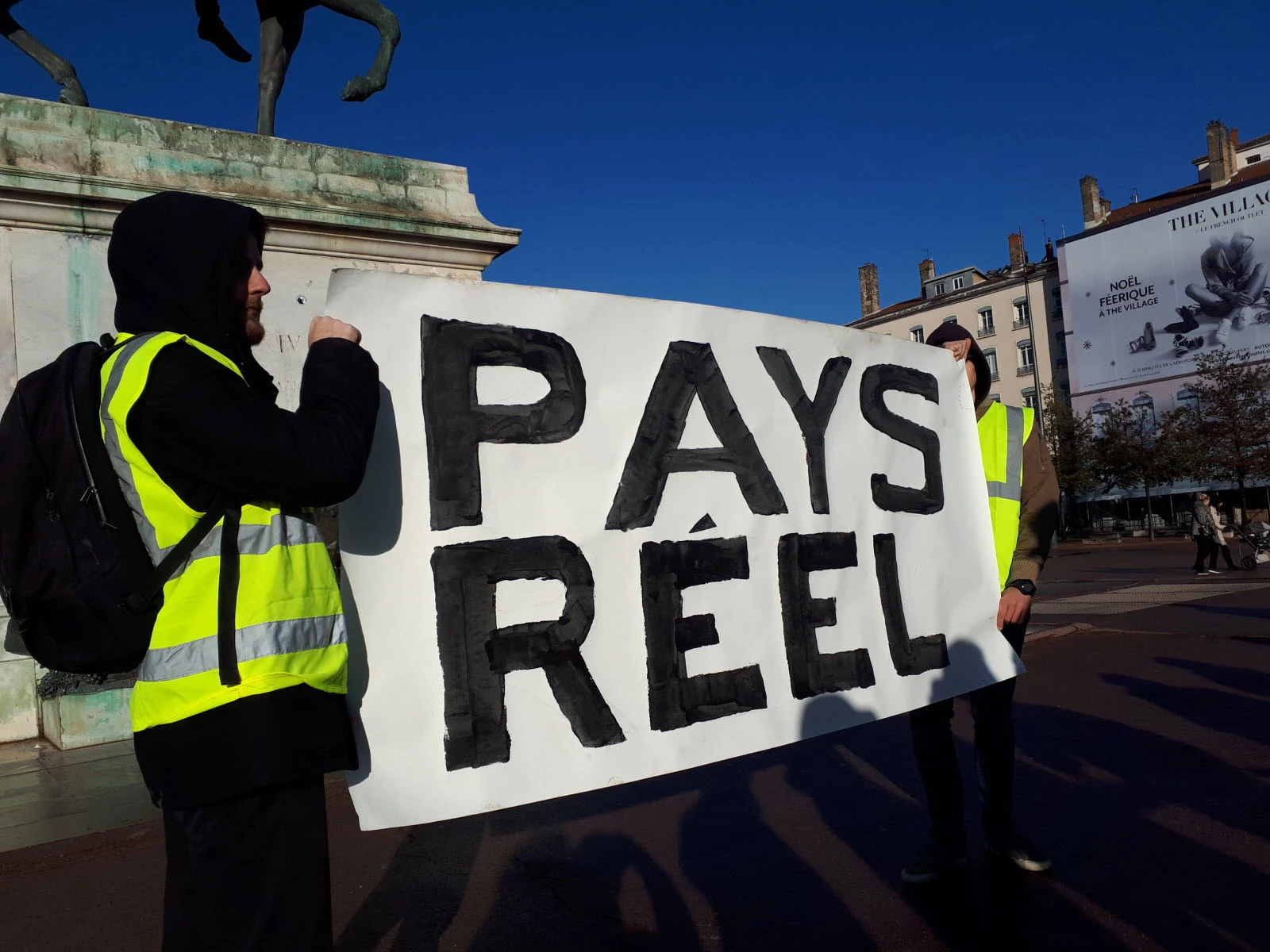
FILE PHOTO — Yellow Vest demonstrators at Place Bellecour in Lyon, France, on 24 November 2018. This genuine archive photograph does not depict the protests of 17 October 2026. Credit: Xavier Breuil. Creative Commons Attribution-ShareAlike 4.0 International (CC BY-SA 4.0). Original JPEG retained unchanged as hero-original.jpg. A WebP derivative was created for the offline preview without adding, removing or compositing visual content. Photo source and reuse terms.
France's 17 October demonstrations over the cost of living, fuel prices and worsening conditions in secondary schools drew hundreds of thousands of people, but the day also brought clashes, fires and looting in several cities. The largest marches were not uniformly violent: Reuters reported that hundreds of thousands joined peaceful street marches while violent fringe groups targeted public buildings, shops and police. [1] [2]
At least 1,200 people had been arrested by the evening, according to figures cited by the BBC and Reuters from the French government. Interior Minister Laurent Nuñez estimated nationwide participation at 550,000. Those figures are changing counts and government estimates, not a count of every person who joined peaceful demonstrations. [1] [2]
Key points - The protests took place on Saturday, 17 October 2026, across France. - The government estimate was 550,000 participants; the CGT union gave a higher estimate of 800,000. - At least 1,200 arrests were reported by the evening, after a lower mid-afternoon tally. - Violence was reported in parts of Paris, Lyon, Limoges, Marseille, Lille and other cities, but the main Paris march was described as largely peaceful during the afternoon.
What happened on 17 October?
The day began with authorised marches and other gatherings in cities across France. In Paris, the main march was largely peaceful in the afternoon, the BBC reported, even as separate groups later set fires, torched vehicles and fought with police around the Place de la République. Police used tear gas, water cannon and batons in some confrontations. [1]
The situation was different in several locations. The BBC reported that a fire at Limoges town hall caused part of its roof to collapse. In Lyon, the tourist office was burned after what the mayor called a tragedy. Reuters also reported that city hall in Marseille was entered and defaced, while shops and a mobile-phone store were looted in different cities. These incidents describe specific groups or episodes; they should not be treated as the conduct or motive of all demonstrators. [1] [2]
EFE reported that an unauthorised group in Paris tried to approach the Élysée Palace, where demonstrations are prohibited, while the authorised march followed its planned route. The report said CRS 8, a police unit used for urban-violence response, was deployed against unauthorised groups. [3]
How did the arrest and turnout figures change?
The numbers depend on when and who was counting. EFE reported 272 arrests nationwide by 3 p.m. local time. By the evening, the BBC and Reuters reported at least 1,200 arrests, with Prime Minister Sébastien Lecornu saying the government would not be intimidated by violence. That later figure is an attributed, evolving count, not a final judicial outcome. [1] [2] [3]
The government’s estimate of 550,000 participants came from Interior Minister Nuñez. Reuters reported that the CGT trade union estimated 800,000, while EFE said the union put the turnout at 500,000. Different counting methods explain the gap. The safest description is that hundreds of thousands took part, with 550,000 as the government estimate. [1] [2] [3]
The same distinction matters for the violence. Reuters said hundreds of thousands marched peacefully, while violent fringe groups attacked police, looted businesses and targeted public buildings. Officials and political leaders blamed organised or “ultra-left” groups, but those claims are political attributions. The available reports do not establish that every participant shared those aims. [1] [2]
Why were students and unions protesting?
The wider mobilisation grew out of student protests that began in September at French high schools, or lycées. Students and supporters have raised teacher shortages, lost lessons when absent staff are not replaced, overcrowded classrooms and badly maintained buildings. Reuters reported complaints ranging from water leaks to rat infestations and said the government was also considering repairs, school-day arrangements and longer lunch breaks. [5]
The government had already promised a limited response. Education Minister Édouard Geffray said on 8 October that 3,000 extra supply teachers would be directed to roughly 500 lycées judged to have the greatest need. The BBC reported that about 140 lycées were fully or partly closed on the following Friday, down from earlier days, while student leaders said they wanted concrete results rather than announcements. [4]
The 17 October action widened that school-based movement. Students were joined by trade union members, workers, retirees, farmers and people associated with the Yellow Vest movement, which challenged fuel-tax and living-cost pressures in 2018 and 2019. Reuters and EFE describe a broad coalition, but its participants did not necessarily share one programme. School funding, fuel prices, purchasing power, inequality and public spending appeared as overlapping concerns. [2] [3]
What was the response from police and political leaders?
Interior Minister Nuñez had mobilised 10,000 police officers and gendarmes nationwide, including 5,000 in Paris, according to EFE. Lecornu said more than 150 police officers were injured. Reuters also reported that police tactics were under scrutiny after injuries during the earlier school protests, including a teenager who lost a hand after picking up a police grenade; the precise circumstances and responsibility for individual injuries should not be inferred beyond the reports. [1] [2] [3]
President Emmanuel Macron said people who attacked prefectures, businesses or town halls would be prosecuted and punished. Lecornu argued that violence could not be allowed to set a political agenda. Jean-Luc Mélenchon, who took part in demonstrations, criticised police conduct while condemning looting and arson, according to the BBC. Marine Le Pen said legitimate demands had been held hostage by the far left. These are competing political responses, not independent findings about who organised every violent act. [1]
What happens next?
The immediate question is whether the government’s school measures reduce the pressure after weeks of blockades and street protests. The 3,000-teacher pledge addresses staff gaps in selected schools, but the BBC reported that it did not amount to the large new investment demanded by some student leaders. The dispute therefore remains tied to practical issues—teacher replacement, building repairs and classroom conditions—as well as broader anger about household costs. [4] [5]
The protests also arrive months before France’s 2027 presidential election, making claims about political influence contested. The verified facts are narrower: a large mobilisation occurred on 17 October; the government estimated 550,000 participants; at least 1,200 arrests were reported by evening; and violence affected some places while many marched peacefully. Those distinctions prevent the entire movement being labelled by its most destructive scenes.
Related reading on Verdvit
Sources and research notes
[1] BBC News — Violent clashes, looting and buildings ablaze in France as over 1,000 arrested after protests
Source record: https://www.bbc.com/news/articles/c6d937wedj7jo. Published: 2026-10-17. Retrieved: 2026-10-18T11:18:42+05:30.
[2] Reuters — Looting and arson in French cities during worst unrest in years
Source record: https://www.reuters.com/world/students-trade-unions-yellow-vests-set-protest-across-france-2026-10-17/. Published: 2026-10-17. Retrieved: 2026-10-18T11:19:53+05:30.
[3] EFE — Hundreds arrested as clashes, fires, looting mar France cost-of-living protests
Source record: https://efe.com/english/economy/2026-10-17/hundreds-arrested-as-clashes-fires-looting-mar-france-cost-of-living-protests/. Published: 2026-10-17. Retrieved: 2026-10-18T11:18:58+05:30.
[4] BBC News — France promises 3,000 extra teachers in first step to calm student protests
Source record: https://www.bbc.com/news/articles/c6vg98lw017po. Published: 2026-10-09. Retrieved: 2026-10-18T11:20:14+05:30.
[5] Reuters — French police use batons, fire tear gas during student protests
Source record: https://www.reuters.com/world/europe/france-braces-day-school-blockades-street-protests-2026-10-06/. Published: 2026-10-06. Retrieved: 2026-10-18T11:21:08+05:30.
[6] Wikimedia Commons — File: Manifestation des Gilets jaunes place Bellecour à Lyon le 24 novembre 2018
Source record: https://commons.wikimedia.org/wiki/File:Manifestation_des_Gilets_jaunes_place_Bellecour_%C3%A0_Lyon_le_24_novembre_2018.jpg. Published: 2018-11-24. Retrieved: 2026-10-18T11:19:58+05:30.
Reporting checked: 2026-10-18T05:48:00Z. Event date: 2026-10-17. Source records provide attribution; navigation and citation links stay on Verdvit.
Article information
Title: France Protests on 17 October: Clashes, Fires and More Than 1,200 Arrests
Description: France’s October 17 protests: reported clashes and arrests, competing turnout estimates, school concerns and living-cost demands.
Topics: France protests, World news, Cost of living, School conditions, Student protests, Paris, Public services