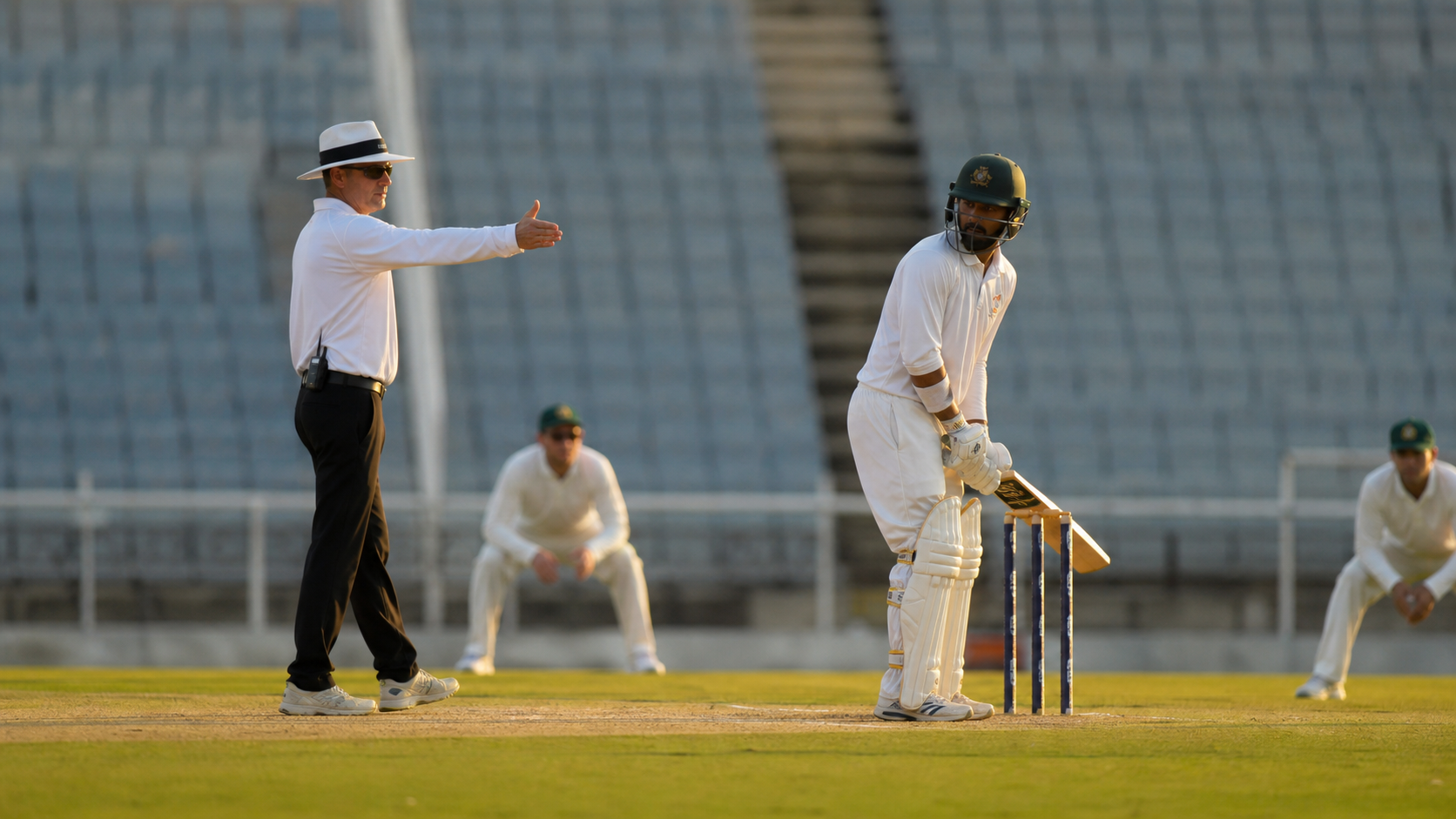
The International Cricket Council has announced an escalating sanction when a batter repeatedly delays being ready for a delivery: two warnings, then five runs awarded to the fielding side for each further offence. The Reuters report also says warnings reset after an innings or 80 overs. It does not report an example of the penalty being imposed. [1]
Key points
- Stepwise sanction: first warning, final warning, then five penalty runs to the fielding side from the third offence onward. [1]
- Warnings reset after an innings or after 80 overs, aligning with established breakpoints in play. [1]
- The rule addresses repeated delays by a batter who is not ready for the next delivery. [1]
- Distinct from the timed-out dismissal for an incoming batter; this targets readiness of a batter already at the crease. [1]
- Announced alongside ball-specification updates and an optional daytime pink-ball Test trial with both teams’ agreement. [1]
What happened
The International Cricket Council introduced a new in-game penalty to address delays by batters who are not ready to face within the prescribed time. Umpires will issue a first warning and then a final warning. From the third offence onward within the relevant segment of play, five penalty runs will be awarded to the fielding side for each subsequent breach. The aim is to deter repeat slow-play behavior without immediately resorting to harsher remedies. [1]
A central operational feature is the reset mechanism: all warnings are cleared after an innings or after 80 overs, whichever checkpoint applies to the format being played. This ensures that sanctions do not snowball indefinitely and that each segment of a match provides a clean slate for compliance. [1]
The Reuters account describes an ICC announcement rather than a specific incident of five runs being awarded in a match. It does not establish when the first penalty will actually be imposed. Readers should distinguish the described playing-condition change from a report about an individual batter or team being sanctioned. [1]
The change was reported alongside other playing-condition updates, including ball-specification adjustments and scope for optional daytime pink-ball Test trials provided both teams agree beforehand. Those items indicate broader technical fine-tuning occurring in parallel with the tempo-focused deterrent aimed at batter readiness. [1]
Why it matters
A five-run award is an immediate, visible consequence that can influence momentum. In tight contests, especially in bowler-friendly conditions, a swing of five runs for each breach beyond the second warning could materially affect session dynamics and decision-making. The escalation from verbal warnings to a runs-based sanction gives umpires a clear, predictable ladder of intervention, reinforcing standards without conflating pace-of-play with individual dismissals. [1]
For captains, the reset at the innings break or the 80-over mark adds clarity. Fielding sides can track when prior warnings lapse, while batters must manage between-ball routines to remain within the set readiness window. That shared understanding may reduce disputes: the thresholds are stated, the checkpoints are known, and the scoreboard reflects non-compliance in a way spectators can easily follow. [1]
Keeping the new sanction separate from the timed-out dismissal also matters for communication and fairness. Timed-out targets a new batter who fails to arrive and take guard in time after a wicket; the new rule addresses a different scenario—delays by a batter already at the crease—using warnings and then team penalty runs rather than an individual dismissal. Maintaining these distinct pathways should limit confusion in pressure moments. [1]
Background and context
Cricket has long grappled with the balance between strategic tempo and time-wasting. Prior deterrents and cultural expectations encouraged efficiency, but enforcement could be uneven when limited to admonitions. By formalizing a stepwise response—warning, final warning, then penalty runs—the ICC provides a codified structure that is easier to apply consistently across formats and venues. [1]
Reuters says warnings reset at the end of an innings or after 80 overs. That detail matters to scorekeeping because the number of prior warnings is part of understanding when a later offence would lead to five runs. Without an actual reported enforcement example, however, the article cannot establish how the sequence will be recorded in a particular match. [1]
The announcement arrived as part of a wider package highlighted by Reuters, which referenced ball-specification changes and a controlled pathway for daytime pink-ball Test trials if both teams agree in advance. While those technical items address conditions and experimentation, the new penalty squarely targets on-field tempo through a scoreboard mechanism familiar from other penalty-run scenarios. [1]
What remains uncertain
Reuters did not detail edge-case procedures for the readiness countdown—for example, how interruptions, equipment issues, or medical assessments interact with the timing. Nor did the report describe any appeals process or detailed documentation method. Questions remain about how first and final warnings will be communicated during match play. The source establishes the warning and penalty sequence, not a special review mechanism. [1]
The frequency with which matches will reach the third-offence threshold is also unknown. Without live examples, it is unclear whether batters will quickly adapt routines to avoid sanctions or whether the deterrent will be tested often in high-intensity spells. Similarly, the report did not forecast enforcement volume across formats, leaving observers to watch early series after the effective date for practical patterns. [1]
The report describes the ICC's stated rule but not its first actual use. Which match, batter or competition will first experience the five-run sanction is unknown. An example, if documented later, would provide a better basis for explaining practical edge cases than speculation today. [1]
What happens next
Attention now turns to how the newly announced rule is implemented in future matches. Teams will likely update dressing-room routines, with coaches emphasizing quicker between-ball readiness and captains tracking warnings as part of on-field management. Umpiring crews will incorporate the explicit escalation steps into match control, recording and communicating warnings before moving to five-run awards on subsequent offences. [1]
Administrators and broadcasters will also prepare for scorekeeping and presentation needs. Because penalty runs are added to the fielding side’s total, graphics and commentary must clearly attribute those awards and note when warnings reset at an innings break or at 80 overs. Early applications—once they occur—should clarify any practical ambiguities and could prompt further guidance from the ICC to standardize procedures for rare or complex scenarios. [1]
As the rule beds in, observers will watch for secondary effects: whether the visible risk of conceding runs accelerates play routines, whether captains adjust field settings or bowling rhythms around readiness windows, and how often matches cross from warnings to penalties. Any detailed implementation notes or documented examples published after initial usage would serve as a review trigger for refinements or clarifications. [1]