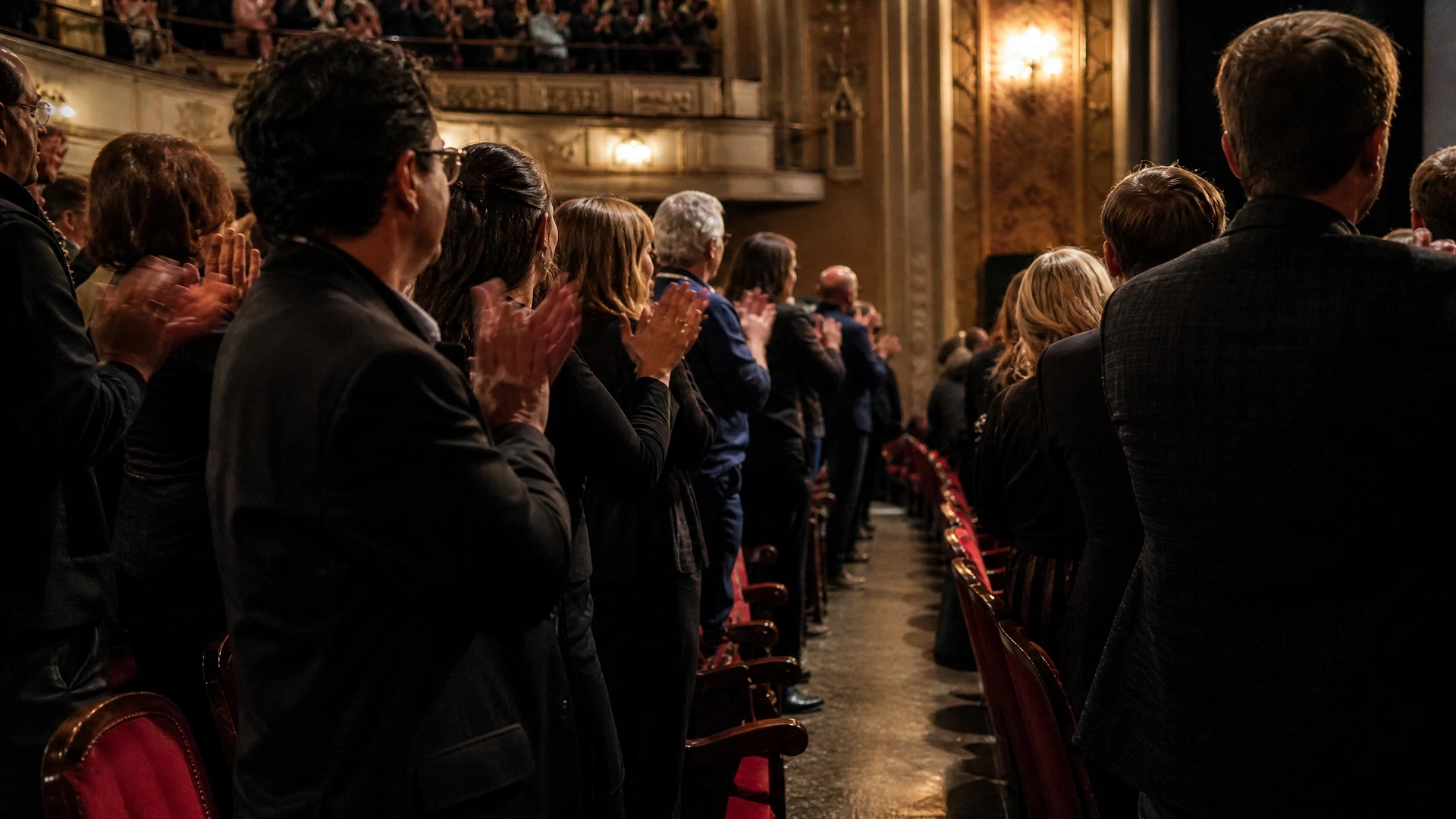
Danny Boyle’s Ink received a reported five-minute standing ovation after its world-premiere screening at the Venice Film Festival on 2 September 2026. The film opened the festival’s 83rd edition in the main competition, with Boyle, writer James Graham and stars Jack O’Connell, Guy Pearce and Claire Foy attending the screening. [1][2]
The film dramatises the transformation of the British newspaper The Sun after Rupert Murdoch acquired the struggling title and recruited Larry Lamb as editor. O’Connell plays Lamb, Pearce plays Murdoch and Foy plays Jules Davies, a character identified by the Guardian as a fictional composite. The project is based on Graham’s own stage play, with Graham writing the screenplay for Boyle’s feature adaptation. [1][3][4]
Key points
- Ink premiered on 2 September 2026 as the opening film and a competition entry at Venice. [2]
- Deadline reported a five-minute standing ovation after the world premiere. [1]
- Jack O’Connell plays Sun editor Larry Lamb; Guy Pearce plays Rupert Murdoch; Claire Foy plays Jules Davies. [1][2]
- The screenplay is by James Graham, adapted from his Tony-nominated stage play. [2][4]
- The story covers the late-1960s and 1970s creation of a more aggressive, mass-market tabloid. [1][3]
- Deadline reported U.S. cinemas from 11 December, Netflix from 8 January and a U.K. theatrical release on 8 January. [1]
What happened at Venice
La Biennale di Venezia announced Ink as the festival’s opening film and confirmed that its world premiere would take place in the Sala Grande at the Palazzo del Cinema on Wednesday 2 September. The official listing places it in the Venezia 83 Competition and gives its running time as 116 minutes. [2][3]
After the screening, Deadline reported that the audience gave the film a five-minute standing ovation. That is a documented audience response, not an award or a measure of the entire critical reception. The same report said the principal actors and filmmakers were in attendance. [1]
The response was followed by a more divided critical conversation. The Guardian’s Peter Bradshaw described O’Connell’s performance as strong and the film as technically confident, while questioning its treatment of Murdoch and the dramatic balance given to a 1969 kidnapping subplot. The BBC likewise reported enthusiastic reviews alongside debate over whether the film presents Murdoch too sympathetically. [5][6]
What happened in the story
Ink focuses on the period in which Murdoch reshaped The Sun with Lamb, a working-class northern newspaper editor recruited to challenge established Fleet Street rivals. The film presents their project as an attempt to create a newspaper built around what its audience wanted to read, including sport, television and sex, rather than the conventions of the existing press. [1][4][5]
The historical frame begins in 1969, when Murdoch bought an ailing British tabloid and hired Lamb. The official festival synopsis describes a group of “visionaries and misfits” pursuing a new kind of news, while Boyle’s director’s statement says the newspaper ultimately challenged the establishment and helped remake the modern media environment. Those are the film’s stated premises; they should not be confused with an independent finding that The Sun alone caused later media developments. [3]
The film also incorporates the kidnapping of Muriel McKay, who was mistaken for Murdoch’s wife. The Guardian review says McKay was killed and that her body was never found, but treats the episode as a potentially uneasy secondary story within the film rather than as a settled explanation for the newspaper’s later influence. [5]
Verified background and context
The production is a screen adaptation of Graham’s play Ink, which was directed on stage by Rupert Goold. La Biennale identifies Graham as the screenplay’s writer and lists Boyle, Tracey Seaward, Tessa Ross, Michael Ellenberg and StudioCanal among the producers or production entities. The official listing places the production across the United Kingdom, France and the United States, with English as its language. [2][3]
The central historical relationship is presented through two different forms of power. Murdoch supplies ownership and strategic ambition; Lamb supplies editorial energy and a willingness to test the limits of tabloid taste. Variety and the official festival announcement both describe the film as an account of Murdoch’s acquisition of The Sun and his decision to entrust it to Lamb. [2][4]
That framing matters because the film is not simply a conventional rise-to-success biography. The BBC reported that Boyle’s Murdoch is portrayed as an anti-establishment figure and that the director resisted making him a one-dimensional monster. The BBC quoted Boyle as arguing that “monster-ising” Murdoch could absolve others of their contribution to the current media landscape, while also noting criticism that the film may be too soft on its subject. [6]
Why it matters for viewers
For audiences, the Venice response establishes attention around a film that connects a specific newspaper history with broader questions about media power, sensationalism and responsibility. The Guardian’s review links the film’s tabloid world to later debates about celebrity culture and modern media, while the BBC says its treatment of Murdoch has prompted disagreement. Viewers should therefore approach the ovation as evidence of an engaged premiere audience, not as a guarantee of consensus or quality. [5][6]
The film’s distribution also creates different access points. Deadline reported that Netflix holds U.S. distribution rights, with a U.S. cinema release scheduled for 11 December before streaming on 8 January. The same report said StudioCanal will release the film theatrically in the United Kingdom on 8 January, alongside releases in several other territories. Dates can change, and the cited report does not establish a single worldwide release date. [1]
What remains uncertain
The most important uncertainty is interpretive rather than logistical: how audiences will judge Ink’s balance between historical drama and moral criticism. The Guardian questioned whether the McKay kidnapping receives enough dramatic weight, while the BBC highlighted the dispute over Murdoch’s sympathetic presentation. Those are reviews and reported reactions, not evidence that the film’s interpretation is historically definitive. [5][6]
It is also too early to infer awards prospects, box-office performance or long-term influence from one festival screening and a reported ovation. No source reviewed for this report establishes those outcomes. The available evidence supports a narrower conclusion: Ink made a high-profile competitive debut, attracted a strong immediate audience response and entered release conversations with a deliberately contested view of its central figure. [1][5][6]
What happens next
The next verifiable step is the film’s scheduled commercial rollout. According to Deadline, Netflix plans U.S. cinema screenings from 11 December followed by streaming from 8 January, while StudioCanal plans a U.K. theatrical release on 8 January. The festival circuit and subsequent reviews will determine whether the Venice reaction develops into broader critical support, but that remains an open question rather than a forecast. [1]
For now, Ink stands as Boyle’s cinematic version of a formative episode in British newspaper history: a Venice competition opener built from Graham’s stage drama, led by O’Connell and Pearce, and received with a reported five-minute ovation. Its lasting significance will depend on how viewers weigh its energetic account of tabloid innovation against the responsibility questions the film itself raises. [2][3][5][6]